

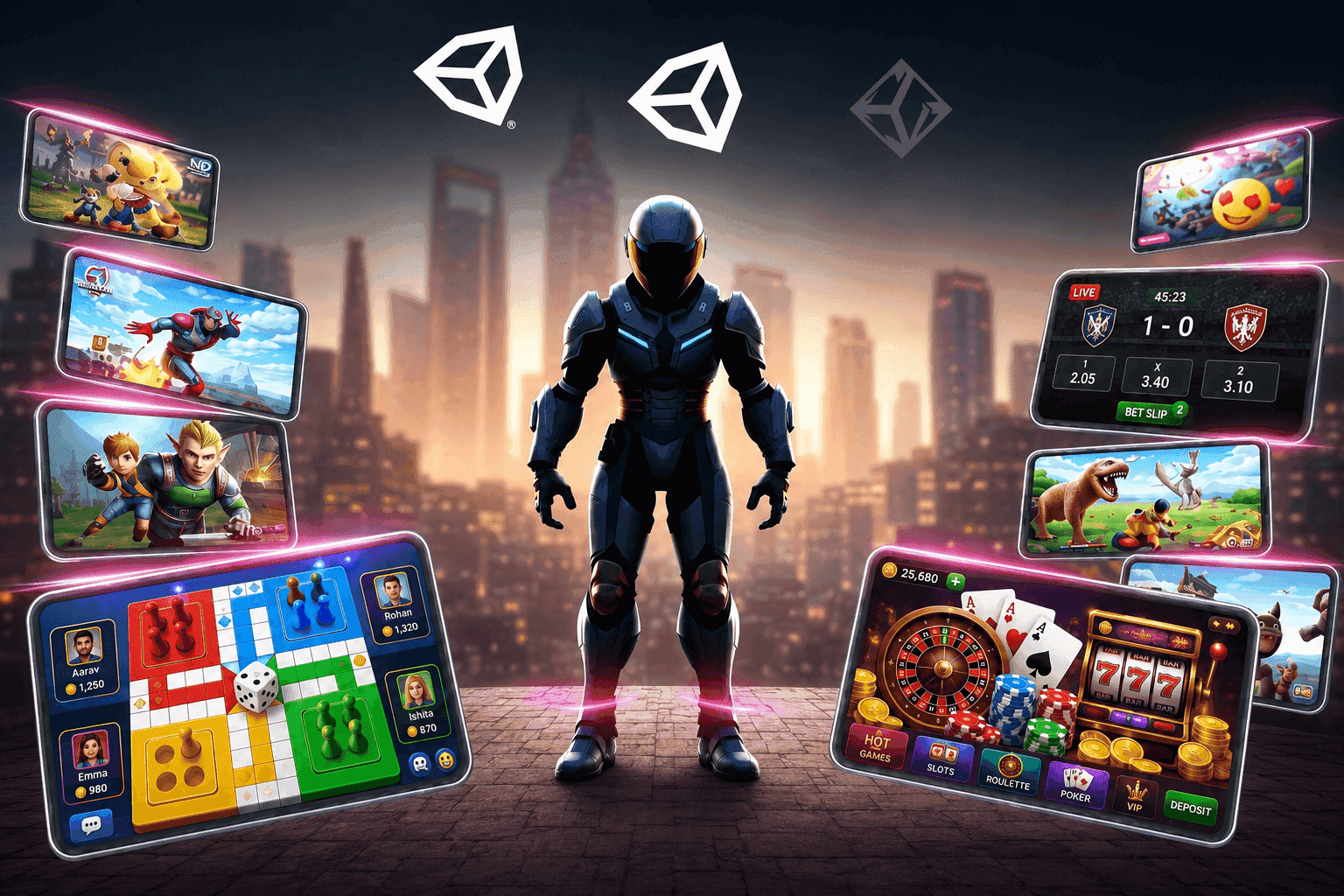
Game economy design
Token sinks, faucets and reward curves modeled against inflation and bot-farming scenarios before launch, not after.
Development · Games
Games built to survive real players, real bots and real secondary markets. Play-to-earn economies, NFT assets and multiplayer infrastructure engineered against adversarial conditions, not a whitepaper simulation.
Corum8 builds blockchain games and Web3-integrated game systems — play-to-earn economies, NFT-based assets, on-chain marketplaces and the multiplayer backend infrastructure that holds up under real player load. Work spans game economy design, smart contract integration, engine development in Unity and Unreal, and the anti-cheat and live-ops discipline that separates a launched game from a launched whitepaper.
What's included
Token sinks, faucets and reward curves modeled against inflation and bot-farming scenarios before launch, not after.
NFT item contracts, crafting and upgrade logic engineered minimal and audited, not bolted onto an existing game loop.
Unity and Unreal engineering for the actual gameplay, with blockchain calls kept off the critical rendering path.
Matchmaking, state sync and server infrastructure built for real concurrent player load.
Embedded wallets and gasless transactions so new players never see a seed phrase before their first session.
Bot detection and exploit monitoring built in from day one — economies without it get farmed within weeks.
In-game and cross-platform marketplaces for item and asset trading, with royalty and fee logic that actually enforces.
Real-time economy dashboards and event tooling for the seasons, drops and balance patches after launch.
Is this you?
You don't need all of them. One is usually enough to justify the call.
Your engine team is strong on gameplay but has never shipped a smart contract or an on-chain economy.
The game design is ready, but nobody on the team has shipped audited NFT or marketplace contracts before.
You have token rewards planned but no simulation of what happens to the economy after month three.
You're seeing bot-driven farming or exploit behavior and the current anti-cheat setup isn't catching it.
Seed phrases and gas fees are showing up in your churn data before players ever finish onboarding.
You're scaling past a beta audience and the multiplayer backend wasn't built for this volume.
Sectors
The platform differs, the economy discipline doesn't.

Reward loops modeled against inflation and bot-farming before launch.

Wallet-embedded mobile games built for mainstream app-store audiences.

Full engine builds with on-chain systems kept off the critical render path.

Item, skin and crafting contracts with real utility beyond speculation.

VR and immersive experiences with on-chain identity and ownership.

Lightweight economies built for high-volume, low-friction play sessions.

Prize-pool and leaderboard infrastructure with verifiable on-chain results.

Blockchain systems layered onto an existing game without disrupting the core loop.
Process
Token sinks, faucets and reward curves simulated against adversarial and bot-farming scenarios before any contract ships.
Gameplay engineering and smart contract integration built in parallel against the same economy model.
Bot simulation, exploit testing and load testing before the economy goes live with real players.
Real-time economy monitoring and balance tooling live from day one, not built after the first exploit.
Case studies
A PC game's NFT marketplace with enforced royalties and a traditional studio's Web3 pilot.
A PC blockchain game needed an in-game and cross-platform marketplace for item trading, with creator royalties that competing marketplaces were routinely bypassing. Building marketplace contracts with enforced royalty logic at the transfer level, rather than relying on marketplace-level cooperation, kept royalty revenue flowing to the studio regardless of where items traded.
An established game studio wanted to pilot NFT-based cosmetic ownership without risking the existing player base's trust or game balance. Layering an opt-in NFT ownership system onto existing cosmetic items, with zero impact on core gameplay balance, let the studio test Web3 adoption without alienating its non-crypto-native majority.
Why Corum8
Every Web3 game starts with a simulated economy, not a token added after the game loop is already built.
Game engine development and smart contract engineering under one roof, not a studio plus a separate Web3 vendor.
Bot and exploit detection designed alongside the economy, not patched in after the first farming wave.
A track record shaped by what actually breaks blockchain games in production, not theoretical security review.
Embedded wallets and gasless transactions so Web3 mechanics don't cost you non-crypto-native players.
Real-time economy dashboards and balance tooling that stay live long after the launch-week spike.
What drives scope
Cost is driven by economy complexity, platform count and blockchain integration depth — not engine choice alone.
A single reward token is lightest. Multi-token economies with crafting, staking and marketplace layers are materially heavier.
Mobile-only is one build. Adding PC, console or cross-platform play multiplies engineering and testing scope.
Cosmetic NFT ownership is lighter than full on-chain economy mechanics with real financial stakes.
Basic bot detection is baseline. Real-time exploit monitoring with automated response is a bigger system.
A static launch economy is simple. Ongoing seasons, drops and balance patches need dedicated tooling and staffing.
Unity is faster to iterate on for most teams; Unreal suits console-grade visual fidelity — the choice shapes team and timeline.
FAQ
Web3 game development is the engineering of blockchain-integrated games — play-to-earn economies, NFT-based assets, on-chain marketplaces — alongside the traditional game engine work of building an actual playable game. The discipline centers on economy modeling and anti-cheat design as much as gameplay engineering, since a blockchain game's token economy is effectively live financial infrastructure the moment it launches.
Cost is driven by economy complexity, platform count, blockchain integration depth, anti-cheat rigor, live-ops scope and engine choice. A mobile-only game with cosmetic NFT ownership is a different budget than a multi-platform play-to-earn economy with marketplace and staking layers.
Unity is generally faster to iterate on and has stronger mobile tooling; Unreal suits console-grade visual fidelity and larger-scale PC titles. Blockchain integration works with either — the choice depends on target platform and team familiarity more than the Web3 layer itself.
Through anti-cheat systems designed alongside the economy from day one — behavioral detection, rate limiting and reward curves that don't reward pure automation. Economies launched without this get farmed within weeks; retrofitting anti-cheat after launch is materially harder than designing it in from the start.
Economy modeling and simulation, game engine development, smart contract integration for assets and marketplaces, wallet and onboarding UX, anti-cheat systems, and live-ops tooling for post-launch operation. Game art and narrative design are typically scoped separately or coordinated with your existing creative team.
Yes — layering NFT ownership or token mechanics onto an existing game loop is common, particularly for studios piloting Web3 adoption without disrupting their current player base. The scope depends on how deeply the new mechanics need to touch existing game systems and balance.
Through embedded wallets and gasless transactions, so a new player can start playing with email or social sign-in and never see a seed phrase before their first session. Wallet friction is one of the most common reasons Web3 games lose mainstream players during onboarding.
On-chain earns its place wherever real ownership genuinely changes how the game is played. Tradable items with provable scarcity, cross-title asset portability, player-run economies and verifiable competitive results all get better with it. Cosmetic or progression systems that players already trust the studio to hold are usually fine staying off-chain, and keeping them there makes the build simpler and the game faster. The strongest Web3 titles we have worked on put a small number of mechanics on-chain and did those extremely well.