

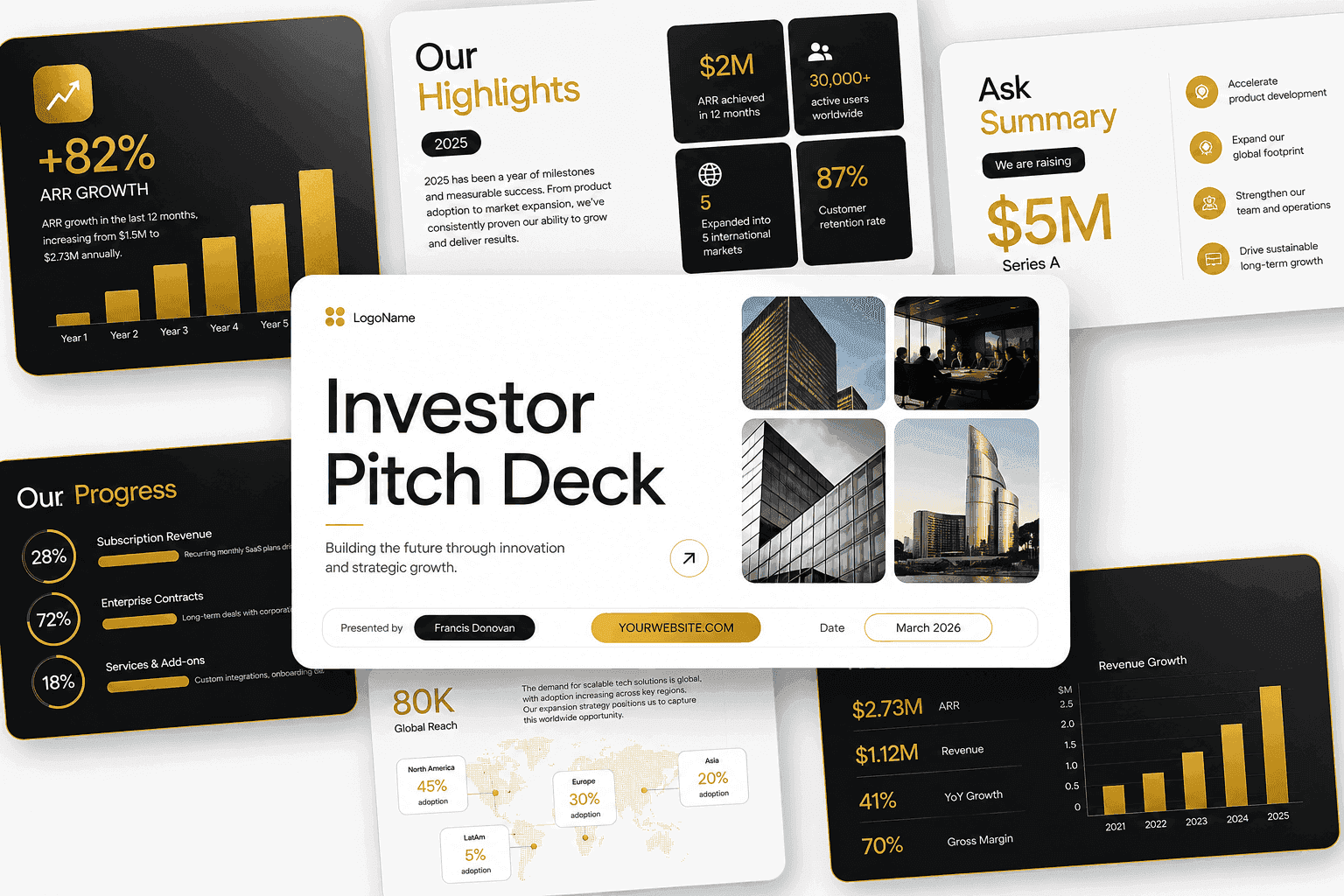
Pitch decks
Investor-ready decks built to survive a partner meeting — narrative arc, market sizing that holds up to diligence, and a design system that scales from seed to Series B.
Marketing · Content & Documentation
Documents built for the audience that actually has to survive them. Pitch decks, whitepapers, one-pagers, litepapers and technical documentation — built for the specific audience each one has to survive, not a template with your logo swapped in.
Corum8 writes and designs the documents that carry a raise, a launch or a technical evaluation — pitch decks, whitepapers, one-pagers, litepapers and technical documentation. Each format has its own audience and its own bar: an investor deck has to survive a partner meeting, a whitepaper has to survive technical diligence, a litepaper has to work as a two-minute read. Built by writers who work alongside the people who actually built the product, not agency generalists paraphrasing a spec sheet.
What's included
Investor-ready decks built to survive a partner meeting — narrative arc, market sizing that holds up to diligence, and a design system that scales from seed to Series B.
Technical and tokenomics whitepapers built for scrutiny — from auditors, technical investors, and a community that reads line by line.
The two-minute version of the whitepaper — for a landing page, a Telegram pin, or the first thing a prospective investor actually reads.
A single page that survives being forwarded without context — for investor intros, partnership conversations, and conference handoffs.
Architecture docs, API references and developer guides written with input from people who can read the code, not paraphrase a README.
Every document traces back to one underlying narrative, so a pitch deck, a whitepaper and a one-pager don't quietly contradict each other.
Decks and papers built inside a real design system — typography, charts, diagrams — not a Google Slides template with a new logo.
Token and securities-adjacent language reviewed against the jurisdictions you're raising or launching in, before anything ships.
Is this you?
You don't need all of them. One is usually enough to justify the call.
A round is in motion and the deck still reads like an internal strategy doc, not an investor narrative.
The product has changed materially since the whitepaper was written, and technical investors are noticing the gap.
You forward a full deck when a one-pager would get read — most first-touch conversations don't survive a 40-slide attachment.
Your technical documentation is either missing or written by someone who's never actually integrated with the product.
The deck, the whitepaper and the website all pitch a slightly different version of what you're building.
Token or securities-adjacent language needs review against rules your last document set never had to account for.
Sectors
The document differs, the discipline doesn't.
Pitch decks built for the first institutional conversations.
Growth-stage decks built to survive a partner's own diligence.
Whitepaper and litepaper pairs built for launch-day scrutiny.
Technical docs written for auditors and integrating developers.
Reference docs and integration guides developers actually use.
One-pagers built for partnership and acquisition conversations.
Whitepapers written for a heavy review cycle.
One-pagers and decks built for enterprise buying committees.
Process
One underlying story built first, before any single document — so every format adapts it instead of reinventing it.
Writers paired with founders, engineers or technical leads, not a generalist working from a brief alone.
Typography, charts and diagrams built to scale across every document in the set, not one-off per file.
Investor, technical or legal review before anything ships — matched to who's actually going to read it.
Case studies
A stalled pitch deck rebuild and a whitepaper diligence fix, both closing a real gap between the document and what the product had become.
A seed-stage Web3 startup had been fundraising for four months on a deck that read like an internal roadmap document — dense, unfocused, no clear ask. Rebuilding the narrative around a single problem-solution arc, with market sizing that could survive a partner's own diligence, gave the founder a deck that got through first meetings instead of stalling after them. The round closed within the following quarter.
A DeFi protocol's whitepaper hadn't been updated since a pre-launch draft, and technical investors kept surfacing the gap between what the document described and what the protocol actually did. Rewriting the whitepaper alongside the engineering team — architecture, tokenomics and risk sections all reviewed by the people who built it — closed the credibility gap and became the reference document the team pointed diligence teams to directly.
Why Corum8
Pitch deck, whitepaper, litepaper and one-pager trace back to the same underlying story instead of quietly contradicting each other.
Documents drafted with the people who actually built what's being described, not a generalist paraphrasing a spec sheet.
An investor deck, a technical whitepaper and a developer doc each get written for how that specific reader actually evaluates a document.
Typography, charts and diagrams built inside a real system — not a template with a logo swapped in.
Token and securities-adjacent language reviewed against your actual jurisdiction before anything ships.
The same team that writes the whitepaper also builds the pitch deck, so the story stays consistent across a raise.
What drives scope
Cost is driven by document count, technical depth and review depth.
A single pitch deck is one scope. A full raise package — deck, whitepaper, litepaper and one-pager — is a different scope entirely.
A one-pager is lighter than a technical whitepaper needing architecture diagrams and tokenomics modeling.
A text-forward document is simpler than a fully-illustrated deck with custom charts and diagrams.
Straightforward consumer content is lightest. Token or securities-adjacent language needing jurisdiction-specific review adds real scope.
A founder-only review is lighter than a multi-stakeholder, investor-facing document needing board or legal sign-off.
A one-time document is a fixed scope. Living technical documentation that updates with the product is an ongoing engagement.
FAQ
Pitch decks, whitepapers, one-pagers, litepapers and technical documentation — the core document types a raise, a launch or a technical evaluation actually runs on. Each format serves a different reader and a different moment: a deck for a partner meeting, a whitepaper for technical diligence, a litepaper for a first-touch read, a one-pager for a forwarded intro, technical docs for developers integrating with the product.
A whitepaper is the full technical and tokenomics document built to survive diligence; a litepaper is the same narrative compressed into a two-minute read for a first touch. Most serious token launches need both — the litepaper gets the initial audience in the door, the whitepaper is what a technical investor or auditor actually reviews line by line.
Yes — investor-ready pitch decks are a core deliverable, built around a single narrative arc and market sizing that holds up to a partner's own diligence, not just a polished slide template. Scope ranges from a seed-stage narrative deck to a full data-room-ready Series B package.
Yes — architecture docs, API references and integration guides, drafted with input from the engineers who actually built the product, not paraphrased from a spec sheet. Documentation that developers actually use tends to cut integration support load measurably.
Document count and format mix, technical depth, design system complexity, review depth, revision cycles and update cadence. A single pitch deck is a different scope than a full raise package built across four formats.
Your counsel does. We write it; they clear it. What we bring is the discipline of writing for that review from the first draft instead of producing something strong and watching it get taken apart. We ask your legal team up front which claims are off the table, draft inside those limits, and send work back while changing it is still cheap. This matters most on whitepapers and litepapers, though any document describing token economics goes through the same loop.
No — a single pitch deck or a standalone technical-documentation engagement is a normal scope on its own, not just part of a full raise package. Most clients start with whichever document is on the critical path — usually the deck if a round is active, the whitepaper if a token launch is close — and add the rest as it becomes relevant.
By building one underlying narrative first, then adapting it per format — instead of writing each document independently and hoping they line up. The same market sizing, the same problem framing and the same numbers appear across every document in the set.
Start with the document that unblocks the nearest decision. For a raise, that is usually the deck and the one-pager. For a technical audience, the whitepaper or protocol documentation. For a product launch, the site copy and the explainers. Teams rarely need the full suite at once, and producing it all up front usually means rewriting half of it after the positioning settles. We scope to the immediate need and build outwards as the story firms up, which costs considerably less overall.