

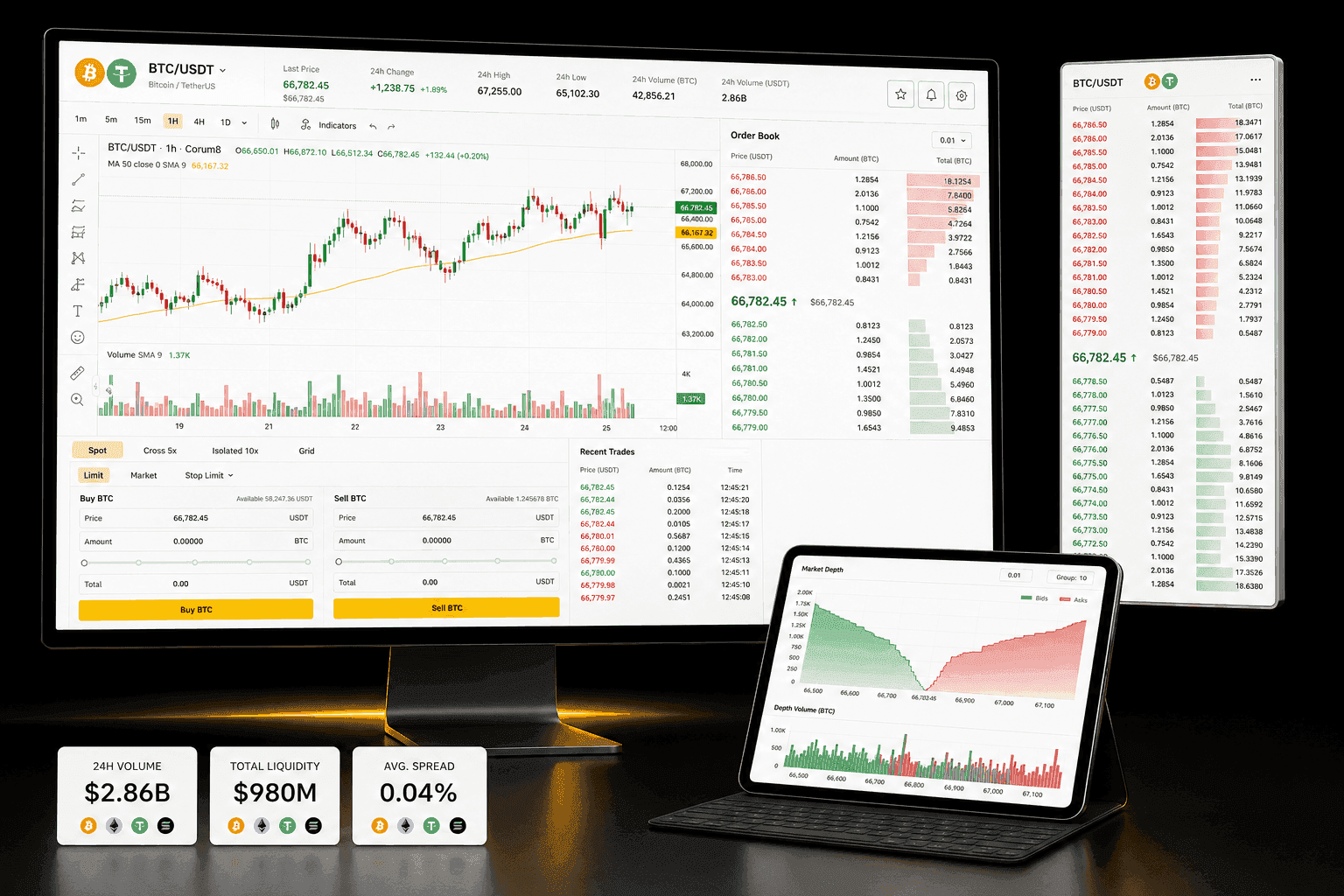
Market-maker relationship management
Coordination with vetted market-making firms providing genuine two-sided liquidity, not a bot script.
Marketing · Exchange Volume
Real market-maker capital, real order-book depth. A token with no liquidity is a spreadsheet. We coordinate the market-maker relationships and incentive programs that make a listing actually tradeable.
Corum8 builds real order-book depth for tokens post-listing — introductions to third-party market makers, DEX liquidity strategy, trading-incentive campaigns and data-accuracy work with CoinMarketCap and CoinGecko. This is legitimate liquidity engineering, not manufactured volume: real market-maker capital providing genuine two-sided quotes, not wash trading or bot-driven fake activity that gets a token delisted the moment an exchange notices.
What's included
Coordination with vetted market-making firms providing genuine two-sided liquidity, not a bot script.
LP incentive design and pool depth strategy for Uniswap, Curve and comparable venues.
Volume-incentive campaigns that reward real trading activity within an exchange's own terms of service.
Verified listings, accurate circulating-supply reporting and the badges that build trader trust.
Liquidity depth managed consistently across multiple venues, not concentrated on one exchange.
The plan for sustaining real trading interest once the launch-week attention spike fades.
Order-book and spread monitoring that flags depth erosion before it becomes a trader-visible problem.
Programs designed to stay clearly inside exchange terms of service and applicable market-conduct rules.
Is this you?
You don't need all of them. One is usually enough to justify the call.
The listing happened, but the order book is thin and spreads are wide enough to scare off real traders.
You're relying on organic trading alone with no professional liquidity provider behind the order book.
Circulating supply, price or verification status is inaccurate, and traders are noticing.
The first week traded well. The weeks since have gone quiet with no clear reason why.
Liquidity is concentrated on one venue while others sit nearly dead, fragmenting your real depth.
A past approach to volume attracted the wrong kind of attention from a venue and needs a clean rebuild.
Sectors
The token type differs, the depth discipline doesn't.

Order-book depth built for the weeks right after a token generation event.

Volume programs coordinated directly with the exchange's own venue.

LP incentive structures for Uniswap, Curve and comparable AMMs.

Rebuilding depth for tokens whose volume faded well after launch.

Liquidity support for tokens tied to gaming and entertainment economies.

Depth programs for tokens bridging crypto-native and mainstream capital.

Liquidity coordination across the specific venues a chain's holders use.

Multi-region liquidity coordination across regional exchange venues.
Process
Order-book spreads, existing market-maker coverage and CMC/CoinGecko data accuracy assessed first.
Vetted market-making relationships structured around the token's actual liquidity needs.
Trading competitions and LP incentives launched within exchange terms of service.
Ongoing spread and volume monitoring so depth erosion gets caught before traders notice.
Case studies
A post-TGE launch that needed liquidity from day one, and a re-liquidity rebuild for a token whose volume had faded months after its original listing.
A token's TGE produced strong opening trading that risked draining once launch-week attention faded. Coordinating a vetted market-maker relationship from the launch date, rather than after the fact, kept spreads tight and depth stable through the first full quarter of trading.
A token's trading volume had faded significantly a year after its original listing, with no active market-maker relationship in place. Rebuilding market-maker coverage and a legitimate trading-incentive program restored meaningfully tighter spreads and sustained daily volume within one quarter.
Why Corum8
Direct coordination with vetted market-making firms, not a bot script sold as liquidity.
Programs built to stay clearly inside exchange terms of service and applicable market-conduct rules.
Liquidity planning starts alongside listing strategy, not as an afterthought once trading looks thin.
Liquidity coordinated across every venue a token trades on, not just the primary listing.
CMC and CoinGecko listings kept accurate and verified, since traders notice when data is wrong.
10+ years coordinating exchange relationships across 30+ venue partnerships.
What drives scope
Cost is driven by venue count, depth target and program duration.
A single-exchange program is lightest. Coordinating depth across multiple venues multiplies market-maker coverage cost.
Modest spread tightening is one scope. Deep, resilient order-book depth for large trade sizes is materially more.
A launch-window program is cheaper than a sustained multi-quarter liquidity commitment.
CEX market-maker coordination and DEX LP incentive design are different disciplines with different cost structures.
Basic listing accuracy is light. Full verification and multi-platform data consistency work is more involved.
A single trading competition is simple. A recurring, multi-exchange incentive calendar needs more coordination.
FAQ
Exchange volume and liquidity marketing is the coordination of real market-maker capital, DEX liquidity incentives and legitimate trading-incentive programs that build genuine, sustained order-book depth for a token. It is distinct from — and explicitly not — the manufacture of fake trading activity, which violates exchange terms of service and typically results in delisting when detected.
No — Corum8 does not build or promote manufactured trading volume, wash trading, or bot-driven fake activity. Every program is built around real market-maker capital providing genuine two-sided quotes, legitimate LP incentives, and trading competitions that operate clearly within exchange terms of service. Manufactured volume gets detected and typically results in delisting; it is not a service we offer.
Cost is driven by venue count, depth target, program duration, whether the work is CEX or DEX-focused, data-verification scope and incentive-campaign complexity. A single-exchange, launch-window program is a different budget than a sustained multi-venue liquidity commitment with ongoing incentive campaigns.
Yes — coordinating relationships with vetted market-making firms is core to the practice, matched to the token's actual liquidity needs and exchange requirements. The right market-maker fit depends on token type, exchange venue and the depth target, not a one-size-fits-all vendor relationship.
Current-depth audit, market-maker relationship coordination, DEX liquidity incentive design where relevant, trading-competition design within exchange terms, CoinMarketCap and CoinGecko data accuracy work, and ongoing depth monitoring. Scope depends heavily on venue count and depth target.
Through direct verification submissions and ongoing monitoring of circulating supply, price feed accuracy and listing status across both platforms. Inaccurate data is one of the fastest ways to lose trader trust — this work is straightforward but easy to neglect once the initial listing is done.
Market-maker coordination can tighten spreads within days of activation; sustained depth resilience typically builds over the following weeks as the market-maker's presence and any incentive programs compound. The timeline depends heavily on starting depth and venue count.
Real demand to trade, and depth arriving before the audience does. The programmes that hold up are the ones where genuine interest already exists and the order book is ready to meet it, rather than depth manufactured in front of an audience that is not there yet. We introduce you to third-party market makers, design the incentive structure, and keep the listing data accurate across the aggregators. The market makers are independent vendors you contract directly — we coordinate, we do not provide the liquidity ourselves.