

Smart contracts
ERC-721, ERC-1155, ERC-2981 royalties, ERC-6551 token-bound accounts, ERC-4907 rentals — plus Metaplex standards on Solana.
Development · NFT
NFT platforms built for the categories still compounding, not the 2021 hype cycle. Marketplaces, mint platforms, licensed IP, music royalties — useful long after the hype fades.
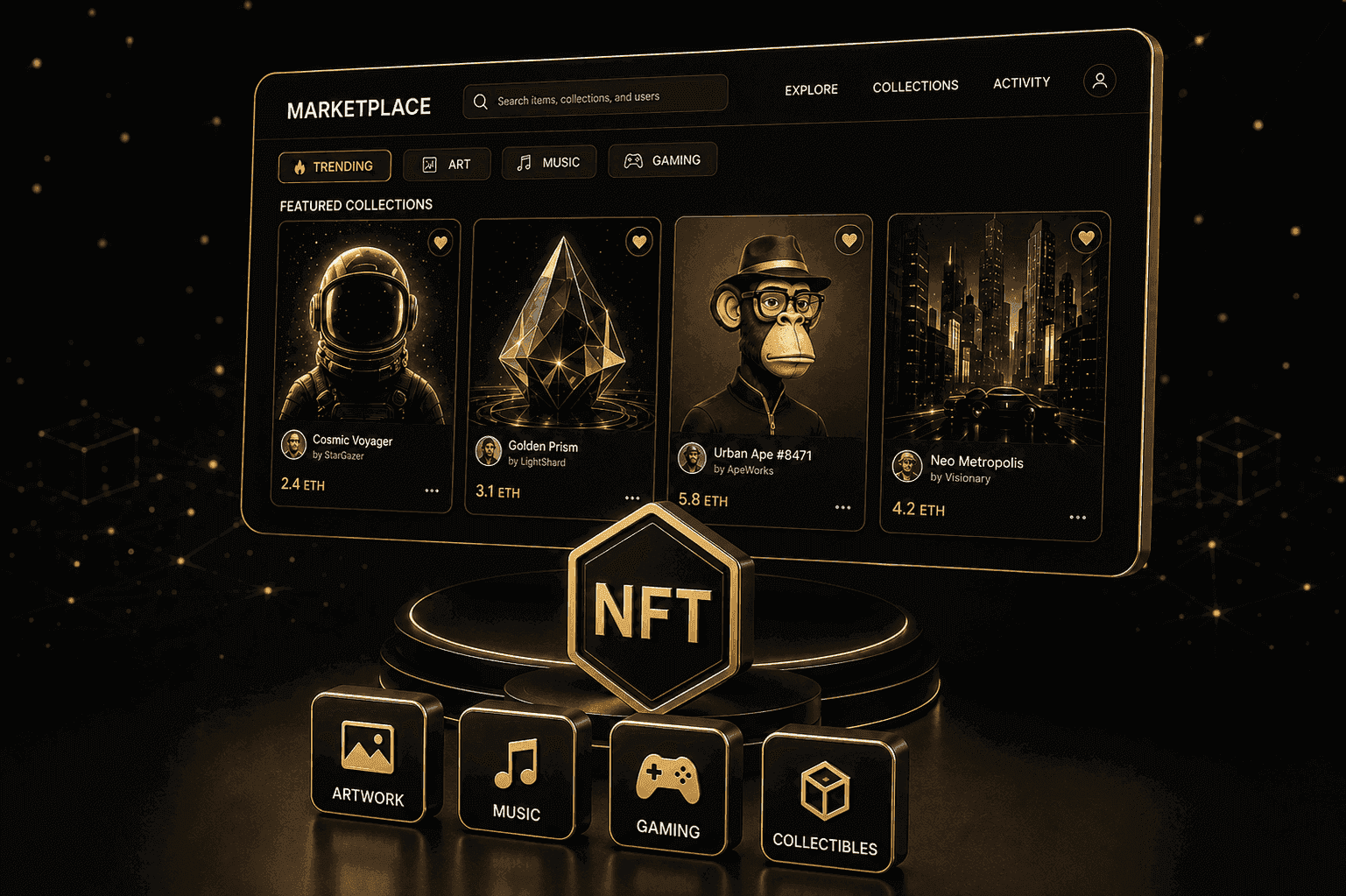
Corum8 builds NFT platforms with genuine product fit — fine-art marketplaces with provenance, licensed IP collectibles, music royalty platforms, ticketing, membership and real-world-asset-backed NFTs. Work spans smart-contract engineering (ERC-721, ERC-1155, ERC-6551, ERC-2981), marketplace mechanics, creator tooling and royalty enforcement.
What's included
ERC-721, ERC-1155, ERC-2981 royalties, ERC-6551 token-bound accounts, ERC-4907 rentals — plus Metaplex standards on Solana.
Batch minting, allowlists, progressive reveals and lazy minting via ERC-721A or Solana compressed NFTs, with fair-queue mechanics that keep bots from dominating launches.
Listing, bidding, offers and auctions built on Seaport or custom contracts, with royalty enforcement via operator allowlists and signed approvals.
IPFS and Arweave for permanent storage, content hashes anchored on-chain, and chain-of-custody records for physical-backed NFTs.
Drop configuration, royalty settings and secondary-sale tracking for creators; moderation queues and takedown mechanisms for platform admins.
Privy, Magic and Dynamic for wallet-free onboarding; MoonPay, Transak and Crossmint for credit-card checkout.
Every contract audited before launch — two audits minimum for marketplace contracts handling escrow and royalty distribution.
Reservoir API, OpenSea API and custom subgraph indexing so performance data isn't locked to a single venue.
Is this you?
You don't need all of them. One is usually enough to justify the call.
Your product genuinely benefits from verifiable ownership and transferability — tickets, memberships, collectibles.
You're routing royalties or revenue shares to creators or contributors in a programmable way.
You're working with a brand partner's licensed IP and need a rights-tracked distribution layer.
Your physical goods — art, watches, rare items — need verifiable provenance and ownership transfer.
Your community genuinely cares about ownership mechanics — not 'we should have NFTs' as a marketing decision.
You're building gaming assets where on-chain ownership meaningfully changes the player experience.
Sectors
The ones still compounding in 2026, not the 2021 JPEG cycle.

Provenance-first marketplaces for serious collectors.

Rights-tracked distribution for established brand partners.
Programmable revenue splits routed directly to fans.

Scalper-resistant tickets and passes with real utility.

On-chain items and characters with pragmatic interoperability.

Certificates of ownership for insured physical assets.

Position NFTs and yield-bearing collectible primitives.

Hybrid Web2/Web3 rollouts for mainstream retail audiences.
Process
Two weeks establishing why this product needs NFTs at all, tested against simpler alternatives.
Token, marketplace and royalty contracts built to the standards the category actually needs.
Creator and admin surfaces, embedded wallets and fiat on-ramp for mainstream users.
Independent third-party audits on every contract before mint — the same fund-safety bar as any DeFi product.
Case studies
Fine-art provenance and programmable music-royalty distribution.
An institutional-grade fine-art platform needed auditable provenance and buyer verification for high-value transactions. Built on Ethereum mainnet with Seaport for trading and an operator allowlist for royalty enforcement, first-year gross merchandise value crossed $18M with secondary royalty collection roughly 3x the OpenSea market norm.
A music royalty platform needed to distribute mechanical royalties across songwriters, producers, labels, performers and fan-NFT-holders at different percentages per jurisdiction. Built on Ethereum with 0xSplits-powered distribution, the first album generated quarterly distributions across three releases.
Why Corum8
Through the speculative wave and into the 2025-2026 utility-first era — none of the platforms we built that survived needed speculation to work.
Contracts, metadata infrastructure, marketplace mechanics, creator tooling and consumer UX under one roof.
Every contract goes to an independent firm before launch — two minimum for anything handling escrow or royalty distribution.
Royalties, licensed IP, ticketing, RWA-backed collectibles — not a 2021 JPEG playbook applied to 2026.
Community building, influencer partnerships and PR that positions the product as distinct from speculative-era NFTs.
IPFS plus Arweave, on-chain content hashes, and chain-of-custody records treated like a financial audit trail.
What drives scope
The expensive decisions happen in product fit and distribution strategy, not contract complexity.
A fine-art marketplace, ticketing with scalper prevention, music royalty distribution and licensed IP collectibles are four different builds with very little shared code.
Ethereum mainnet for institutional credibility, Polygon/Base/Arbitrum for cost-sensitive consumer products, Solana compressed NFTs for very large collections.
Direct-to-crypto-user is lightest; embedded wallet flow for mainstream users adds onboarding UX; physical-world distribution adds real logistics.
Primary-only is simple; an internal secondary market with royalty enforcement, or cross-marketplace integration, adds real scope.
Fixed-percentage ERC-2981 is simple; multi-recipient splits for music royalties need Splits.org or 0xSplits integration.
Ordinary digital collectibles are the simplest build; royalty-claim NFTs and RWA-backed NFTs carry custody, insurance and securities considerations.
FAQ
NFT marketplace development is the engineering of platforms where unique ownership tokens are minted, traded and connected to real product utility — collectibles, music royalties, licensed IP, ticketing, membership or physical-asset-backed certificates. Builds include smart contracts, minting infrastructure, marketplace mechanics, metadata and provenance storage, creator and admin tooling, and consumer UX that often includes embedded wallets and credit-card checkout.
Cost is driven by NFT category, chain choice, distribution strategy, secondary-market scope, royalty enforcement and legal framework — not the token contract itself, which is usually a small piece. A primary-only drop on Polygon is lightest; a full marketplace with cross-chain support, embedded wallets and secondary royalty enforcement is an order of magnitude heavier.
Yes, for specific use cases — the speculative PFP market is mostly gone, but NFT as a functional primitive keeps growing: music royalties, licensed IP distribution, scalper-resistant ticketing, membership passes, gaming assets and RWA-backed collectibles. If your product thesis needs verifiable ownership or programmable royalty distribution, NFT infrastructure is the right tool.
Smart contracts, minting infrastructure with allowlist support, marketplace mechanics, IPFS and Arweave metadata storage, creator and moderation tooling, embedded-wallet UX, fiat on-ramp integration and cross-marketplace analytics — shipped with independent third-party audits coordinated on every contract. Creator onboarding itself and physical custody operations for RWA-backed NFTs sit outside the build scope.
Through operator allowlists, signed-transfer patterns and token-bound enforcement — plus choosing which marketplaces your NFTs are listable on in the first place. Operator allowlists restrict which contracts can move your tokens, the industry response to Blur-era zero-royalty defaults. None of these are perfect, but all beat hoping marketplaces honor ERC-2981 metadata voluntarily.
Ethereum mainnet for institutional-grade art and fine collectibles, Polygon, Base or Arbitrum for cost-sensitive consumer products, and Solana with compressed NFTs for very large collections where mint economics matter. The choice depends on where your buyers already hold crypto and which marketplace is your primary discovery venue.
Yes — in 2026 this is the norm for consumer products, with embedded wallets and fiat on-ramp removing the crypto-native friction entirely. Privy, Magic and Dynamic create wallets silently on first login; Crossmint, MoonPay and Transak handle credit-card checkout. The chain-ownership benefits remain, but the UX reads closer to standard ecommerce than to a crypto exchange.
Through IPFS for distributed hosting and Arweave for permanent storage, with content hashes anchored on-chain so the reference itself is immutable. Collections hosted only on a centralized URL lose their metadata the moment that host shuts down — permanence has to be designed in from the start, not bolted on after launch.
Yes — rights-tracked distribution layers for brand partners are a core part of our licensed-IP work, with royalty splits routed directly to the studio or rights-holder. We bring in rights-management specialists for these builds specifically, since the legal structure around licensed IP differs meaningfully from an original collection.
The ones where the token does a job nothing else does as well. Provable provenance for fine art, rights-tracked licensed IP, music royalty splits that route automatically, scalper-resistant ticketing, membership that holders can actually transfer — these keep growing long after the collectible cycle cooled. The common thread is real utility behind the token rather than the token being the product. We start by mapping what the NFT unlocks for your users, then build the mechanics around that answer rather than the other way round.