


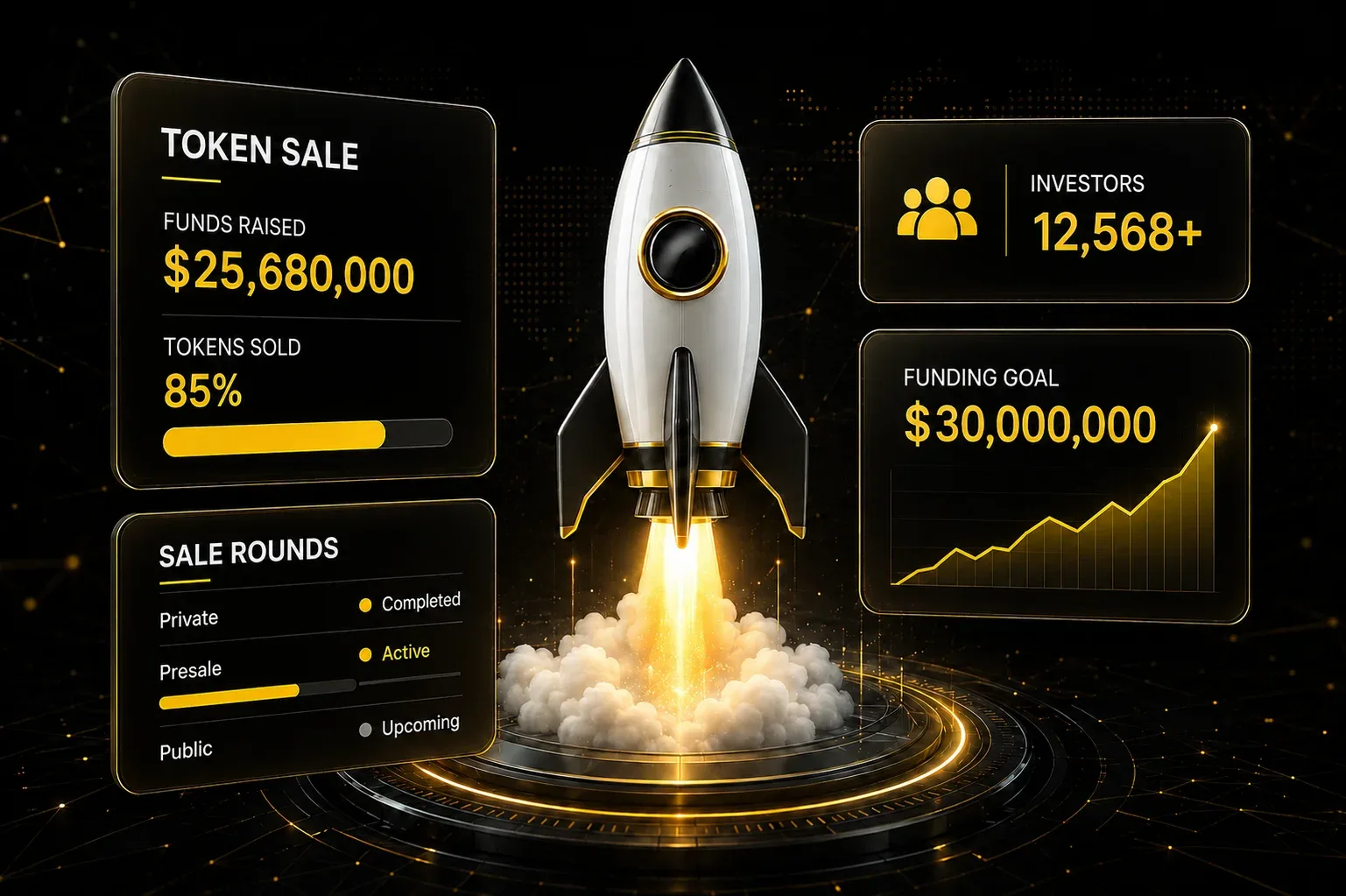
Pre-sale awareness building
Content and PR that build genuine interest weeks before the sale window opens, not a last-minute push.
Marketing · Token Sale
A vetted creator network and a track record of token launches. PR, influencer, community and listing coordinated around one TGE date — not five campaigns that happen to overlap.
Corum8 runs the marketing campaign around a token generation event — PR, influencer activation, community mobilization and listing coordination planned against a single launch date instead of run as disconnected efforts. The work covers pre-sale awareness building, sale-window activation, and the post-TGE community and liquidity narrative that keeps a token relevant past its first week.
What's included
Content and PR that build genuine interest weeks before the sale window opens, not a last-minute push.
Coordinated creator waves timed to the sale window, drawn from a 25,000-creator vetted network.
Discord and Telegram engagement built to a real peak at the sale window, not left flat from launch day.
Exchange listing timing planned against the same calendar as the rest of the campaign, not negotiated separately.
Campaign creative built specifically for the sale mechanics — allocation, vesting, timing — not generic hype copy.
Launch-week press coverage placed to land alongside the sale, not weeks before or after it matters.
The story that carries a token past its first week, when most launch-week attention typically evaporates.
Campaign messaging drafted against the claim limits your counsel sets, and back in front of them before anything ships.
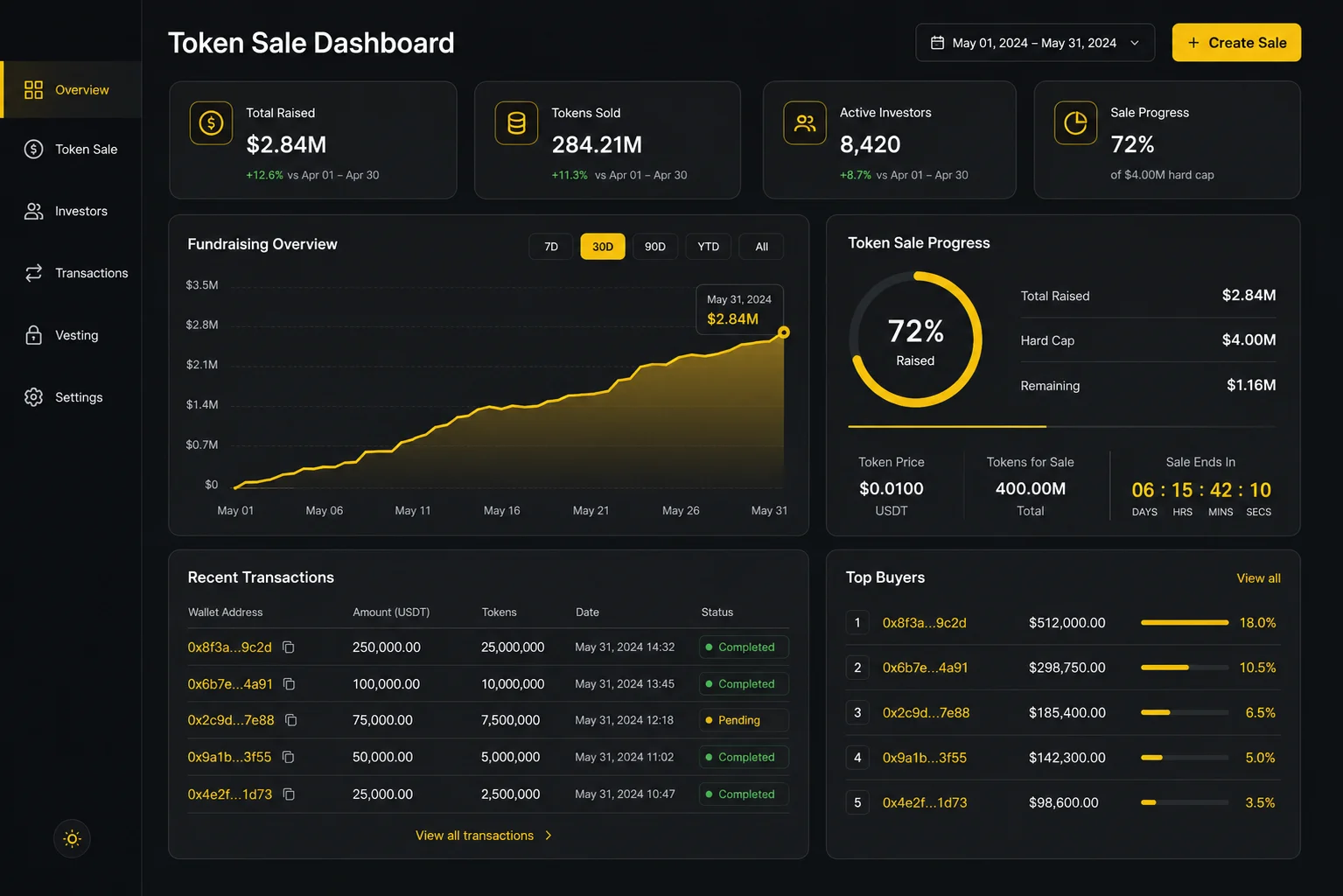
How a sale actually comes together
A token sale isn't one event. It's three, each with its own allocation, price and vesting schedule — and each one needs a different message to a different audience. We build the campaign calendar off the actual tokenomics, so PR, influencer waves and community activation land when the token mechanics say they should.
Funds & strategic backers
They're underwriting risk before there's a market. The questions are unlock schedule, cliff length and what protects them on the downside.
Early community & partners
Allocation size and vesting terms decide who shows up. This is the round that seeds the community an exchange will later want to see.
Retail buyers
Utility and timing carry this one. The story has to be legible in a scroll, and the press has to land the same week — not the week after.
Is this you?
You don't need all of them. One is usually enough to justify the call.
You know when the token launches. You don't yet have a coordinated campaign to fill the weeks around it.
A prior token launch had strong opening attention that fell off a cliff almost immediately.
Exchange listing timing and campaign timing are being negotiated separately by different people.
You have a Discord or Telegram, but it isn't yet activated toward the actual sale window.
A single-creator deal isn't enough — you need a coordinated wave of activation around the launch date.
You're launching somewhere your legal team needs to see the campaign copy before it goes out, and that loop has to be planned for.
Sectors
The token type differs, the campaign coordination doesn't.

Campaigns built around real product access, not speculation alone.

Launch narratives that explain what the token actually controls.

Community-native campaigns for gaming and entertainment audiences.

Developer-and-investor dual-audience campaigns for chain launches.

Campaigns bridging crypto-native and mainstream-finance audiences.

Launch campaigns coordinated directly with the exchange's own audience.

Trust-building campaigns distinct from speculative token launches.

Campaigns tied to real protocol usage and TVL, not just the sale event.
Process
Every workstream — PR, influencer, community, listing — mapped against the actual TGE date first.
Content and early press build genuine interest in the weeks leading into the sale window.
Influencer waves, community mobilization and tier-1 press land together at the moment that matters most.
Community and content continue past launch week, when most campaigns quietly stop.
Case studies
A gaming utility token that kept engagement above the typical post-TGE drop-off, and an infrastructure chain launch that reached both developers and investors.
A gaming token's sale window needed press, influencer activation and community mobilization to land together rather than drift across separate timelines. Building one campaign calendar anchored to the sale date meant engagement stayed materially above the typical post-TGE drop-off through the following weeks.
An infrastructure chain's token launch needed to reach both a developer audience evaluating the technology and an investor audience evaluating the token. Running parallel tracks — technical content for developers, investor-facing press for the sale — reached both audiences without diluting either message.
Why Corum8
PR, influencer, community and listing all planned against the same TGE date instead of five separate timelines.
Influencer activation at the scale and speed a sale window actually needs.
Exchange listing coordination handled by the same team running the rest of the campaign.
We get the claim limits from your counsel at the brief, not after a draft comes back covered in red.
A post-TGE narrative built in from the start, not scrambled together once attention has already faded.
Pattern recognition from what actually sustains attention past the first week versus what doesn't.
What drives scope
Cost is driven by launch ambition, creator-wave size and jurisdiction complexity.
A quiet, organic launch is lighter than a coordinated tier-1 press and multi-creator activation campaign.
A handful of aligned creators is one scope. A coordinated 40-creator wave requires more coordination overhead.
A single DEX listing is lightest. Coordinated CEX listings with market-maker timing add real scope.
A single-market launch is simpler than a multi-region campaign where the messaging has to be localised and re-reviewed for each one.
Mobilizing an existing engaged community differs from seeding one from zero ahead of the sale.
A single-week campaign is one budget. A sustained multi-month post-TGE narrative program is another.
FAQ
Token sale marketing is the coordinated campaign around a token generation event — PR, influencer activation, community mobilization and listing timing planned against one launch date instead of run as separate, disconnected efforts. The goal is genuine attention at the sale window plus a narrative that carries past the typical post-launch attention drop-off.
Cost is driven by launch ambition, creator-wave size, listing complexity, market count, community maturity and post-launch narrative duration. A quiet organic launch is a different budget than a coordinated tier-1 press and 40-creator activation campaign running across several markets at once.
Yes — listing timing is planned against the same campaign calendar as PR, influencer and community activation, rather than negotiated on a separate track. Coordinating both means the launch lands with liquidity and attention arriving at the same moment.
Through a post-TGE narrative built into the campaign from the start, not added once attention has already dropped off. This usually means community programming, ongoing content and a genuine reason to keep paying attention beyond the initial sale event itself.
Pre-sale awareness building, influencer and KOL activation, community mobilization, listing coordination, sale-window creative, tier-1 press coordination, post-TGE narrative work, and campaign messaging drafted for your legal review. Scope depends heavily on launch ambition and jurisdiction complexity.
Your counsel does, and on a token sale you want that loop built into the schedule rather than bolted on at the end. We ask them up front which claims are off the table, write inside those limits from the first draft, and route everything back before it ships. A sale campaign is the worst possible place to find a problem late, because by then the creative is already scheduled across creators, press and community channels at once, and pulling one thread moves all of it. What we will not do is tell you what the rules are — we are marketers, not advisers. The review belongs at the brief stage, not as a final check after the content exists.
Yes — public-sale marketing and private-round investor communication require different messaging and different audiences, and we coordinate both under the same campaign timeline where a project runs both tracks. The public campaign and the private-round narrative need to stay consistent with each other.
Size the campaign to the audience you can genuinely serve on the day. A large multi-channel push works when the product, the community and the support surface are all ready to meet the traffic it creates. Where those are still being built, a tighter campaign aimed at a smaller, better-matched audience converts considerably better per dollar and leaves you with holders who stay. We scope against your launch readiness rather than against the biggest campaign the budget could buy.