

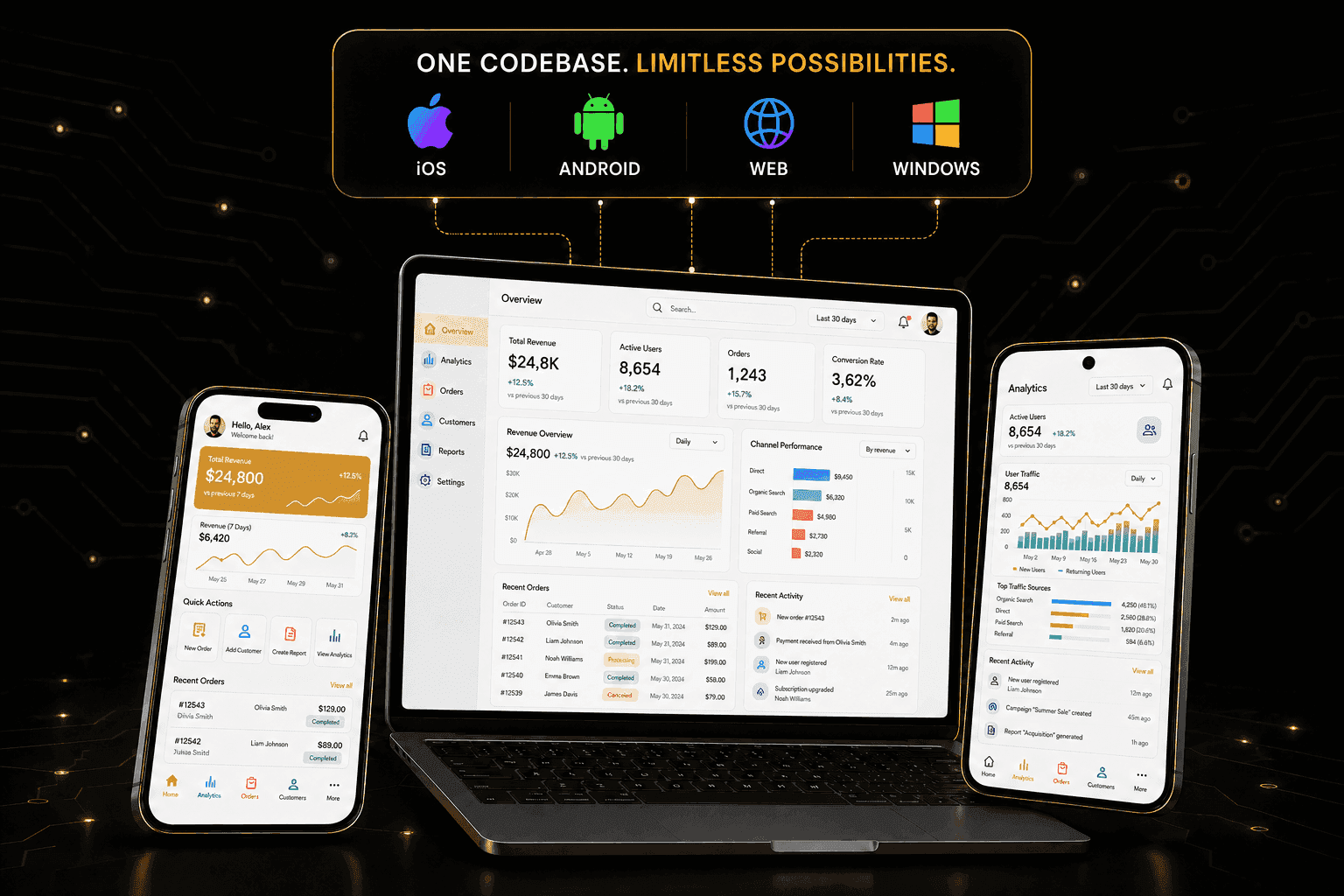
Product surface & navigation
Platform-native navigation and gesture language — a tab bar on iOS should feel iOS-native, not a cross-platform compromise.
Development · Apps
Mobile and web apps shipped at App Store quality, not a cross-platform compromise. iOS, Android and web — wired to your real wallet, AI and payment rails, not bolted-on Web3 buttons.
Corum8 builds consumer and enterprise mobile and web apps for Web3, AI and fintech products. Work covers native iOS (Swift), native Android (Kotlin), cross-platform (React Native, Flutter), web (React, Next.js) and the integration layer that connects these surfaces to wallets, AI systems, payment rails and the rest of modern product infrastructure.
What's included
Platform-native navigation and gesture language — a tab bar on iOS should feel iOS-native, not a cross-platform compromise.
Email or social sign-up with a wallet created silently via Privy, Magic or Dynamic — plus WalletConnect for users who already have one.
TanStack Query, wagmi and viem for Web3 data; SwiftData, Room and Zustand where the platform calls for it.
Wallet signing, AI streaming, payment intents, push notifications — with typed schemas and graceful degradation when endpoints fail.
60fps on the main thread, sub-1s time-to-interactive on web — the layer that separates 'works' from 'feels great.'
App Store and Play Store submission planned for review from day one, staged rollouts, OTA updates via EAS.
PostHog or Amplitude wired to real business metrics, and Sentry for crashes.
A shared design system built in Figma and in the codebase, so platform surfaces stay consistent as the product grows.
Is this you?
You don't need all of them. One is usually enough to justify the call.
Your current app was built by a generalist agency and the mobile experience is visibly worse than the web product.
You're launching a consumer crypto product and review has already bounced your first attempt.
Usage is heavy from mobile, but the app is essentially a wrapper around the web experience.
You're adding embedded-wallet UX and the existing mobile team hasn't shipped this before.
Slow list scrolling, laggy navigation, delayed data — the complaints are specific and repeated.
You're targeting a market where App Store aesthetics and review turnaround genuinely decide launch timing.
Sectors
The platform mix differs, the engineering discipline doesn't.

Native iOS and Android quality with institutional-grade UX built in.

Token-gated tools and on-chain identity on cross-platform React Native.

Biometric approval chains and hardware-key attestation for institutional teams.

Stablecoin complexity hidden behind a two-tap send flow.

Streaming AI interfaces that feel instant on both platforms.

Self-custody and embedded-wallet products built for daily use.

Server-rendered web as the primary surface where web distribution fits.

Low-latency, high-frame-rate interfaces for real-time product experiences.
Process
Two weeks deciding iOS-only vs iOS+Android, native vs cross-platform, and release cadence — before any framework choice.
Navigation, auth and onboarding, data layer and integration layer engineered against the platform strategy.
TestFlight and Play Store internal tracks from week one, not the end — integration and performance issues surface while they're cheap.
Launch with instrumentation and App Store Optimization live, not bolted on after the first user complaint.
Case studies
A Web3 social app that cleared App Store review on the first submission and an enterprise custody dashboard built for institutional security teams.
A seed-stage social app built on a decentralized social protocol with token-gated creator tools needed rapid, identical iteration across iOS and Android. A cross-platform build with a custom social-protocol client, WalletConnect for power users and embedded wallets for mainstream users, and OTA updates for post-launch iteration, passed App Store review on the first submission after careful crypto-feature framing.
A Series B enterprise mobile dashboard for institutional crypto custody operators needed biometric approval chains, interactive push notifications and hardware-key attestation for high-value transaction approvals. Native iOS and Android with Face ID chains, passkey authentication and NFC hardware-key support shipped to 12 enterprise customers with near-zero friction onboarding for their security teams.
Why Corum8
Across Web3, AI and fintech categories — through iOS 9 to iOS 18, and React Native 0.44 to 0.77.
Our engineering instincts come from users with real opinions, not from theorizing about mobile development.
Native iOS, native Android, cross-platform, web and the backend-for-frontend under one roof and one release lead.
No split between a mobile shop, a crypto integrator and a separate web studio.
App Store Guidelines and privacy disclosures worked through before submission, not discovered during it.
ASO, launch coverage and creator partnerships alongside the build — apps need distribution, not just code.
What drives scope
Cost is driven by platform decisions, integration surface and polish target — not feature count, which is almost always overstated.
Two native codebases is more work than one React Native codebase, which is more than a web-only product — driven by platform-integration needs.
iOS only is lightest. iOS plus Android adds 40-60%. Add web and desktop and you're running three or four surfaces.
A REST-backed app is simpler than one with wallet signing, AI streaming, push notifications and native payment intents.
A fully-connected app is simple. Offline sync or real-time collaborative state is a materially different engineering project.
'Works and looks fine' is one budget. 'Feels like Cash App' is another — animation, layout resilience and performance tuning add up.
App Store Guidelines, privacy manifests and ATT prompts are an engineering exercise, not a checklist item.
FAQ
It's the engineering of consumer and enterprise surfaces — iOS, Android, web, sometimes desktop — built to production consumer-software quality and integrated with the real infrastructure a Web3, AI or fintech product needs. This category requires specific integration expertise: embedded-wallet flows, streaming AI UIs, stablecoin payment rails, App Store review preparation for crypto apps, biometric and passkey authentication, and analytics tied to product-specific metrics rather than generic page views.
Cost is driven by platform choice, platform count, integration depth, real-time or offline requirements, polish target and platform-review complexity — not feature count, which teams consistently overestimate. Native iOS is one build; iOS plus Android native is 40-60% more; adding web is a third codebase. Cross-platform reduces platform-count cost but adds integration friction for deep-native features.
Native when deep platform integration, polish or App Store positioning dominates; React Native when the team is JavaScript-native and cross-platform parity matters; Flutter when animation fidelity or Dart-native expertise justifies it. React Native is the default for most 2026 cross-platform builds — Expo and EAS tooling has matured, and Hermes engine performance is strong. Native remains the right answer for premium consumer products or deep-platform-integration requirements.
Product surface engineering, navigation and IA, authentication and onboarding including embedded-wallet flows, data layer and state management, integration to your product backend, performance tuning, App Store and Play Store submission preparation, CI/CD for releases, observability and design-system implementation. The backend product itself stays yours — we integrate, not build the protocol or AI model — and App Store review outcomes are Apple's and Google's decision, not ours to guarantee.
We default to Privy, Magic or Dynamic for most consumer Web3 apps in 2026 — they've solved onboarding friction without requiring users to manage seed phrases. The shape: a user signs in with email, social or passkey, a wallet is created silently, and it's controlled by a combination of device keys and cloud-backed recovery. WalletConnect runs as a parallel path for users who already have a wallet, and recovery flows are designed explicitly for the 'lost phone abroad' case.
Through specific framing choices, close adherence to App Store Guidelines on crypto and financial services, accurate privacy-manifest disclosures, and avoiding patterns that trigger rejection. The most common rejection reasons are in-app-purchase bypass, unlicensed financial-services framing and inaccurate app descriptions. We pre-review submissions against current guidelines and test with TestFlight — first-submission approval on our crypto apps runs above 95%.
For most developed-market consumer crypto products, iOS drives more revenue per user. For most emerging-market products across Southeast Asia, MENA, Latin America and Africa, Android drives the majority of users. The right split depends on target market — platform priority should match your target user base, not developer convenience.
Native earns its place when you need the device — biometrics, secure key storage, push, NFC, camera, offline behaviour. Crypto, fintech and anything holding credentials usually qualify immediately. Where the experience is mostly content and forms, a strong responsive web build reaches everyone instantly with no install step and no review queue. Many products are best served by web first and native once usage justifies it. We scope against what your product actually needs from the hardware, not against a default.