

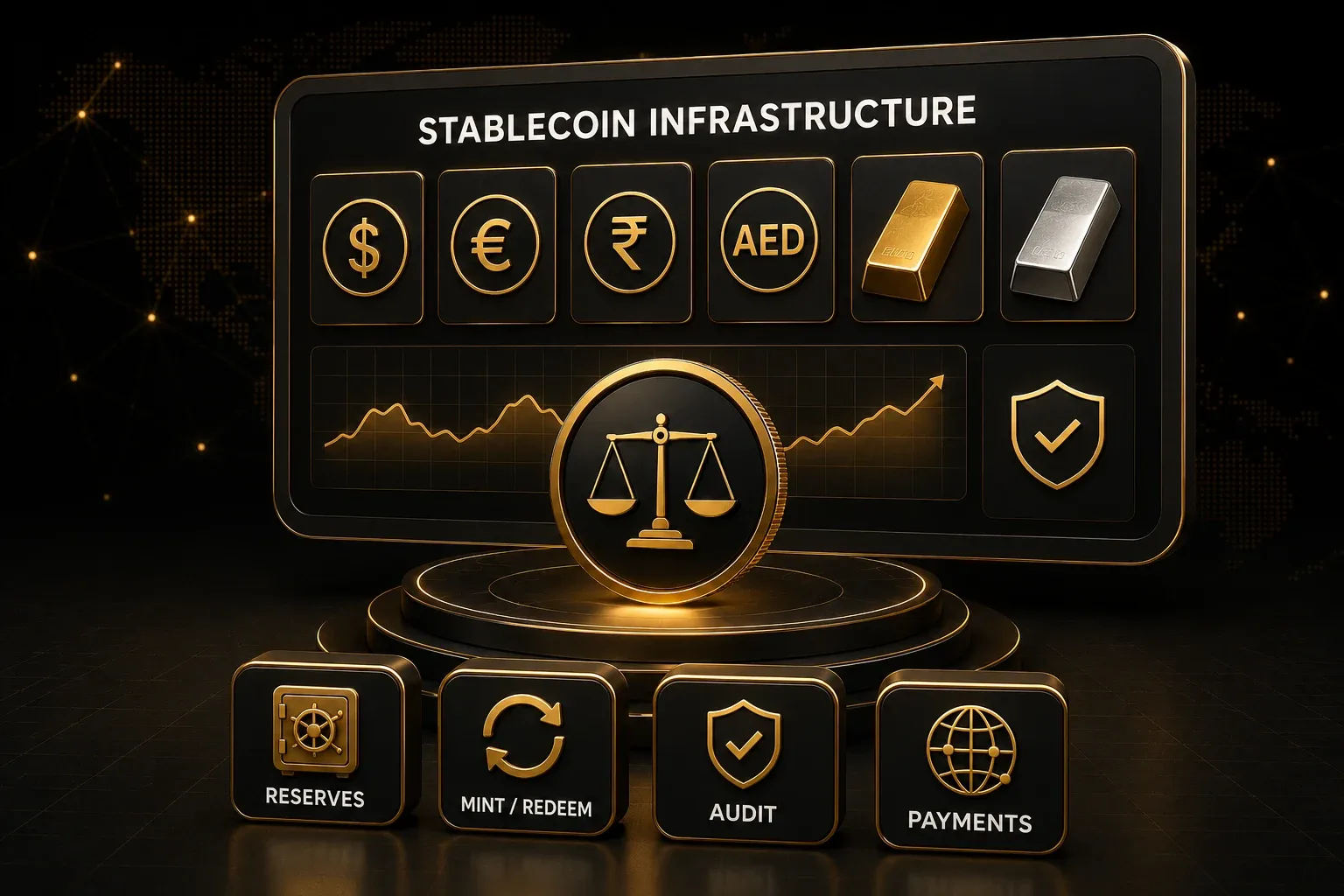
Tokenomics modeling
Three-year supply and demand simulation under adversarial assumptions — 50% holder dumps, mercenary LP exits, flat price action — before a line of code.
Development · Tokens
Tokens engineered for the second year, not the first week. Utility, governance, security, stablecoin — tokenomics, contracts and distribution built to survive past launch day.
Corum8 designs and ships tokens — utility, governance, security and stablecoin — alongside the tokenomics, smart contracts, distribution mechanics and launch operations that make them useful beyond week one. Work spans token architecture, vesting and emissions, treasury design, exchange-listing support and post-launch liquidity and governance.
What's included
Three-year supply and demand simulation under adversarial assumptions — 50% holder dumps, mercenary LP exits, flat price action — before a line of code.
ERC-20, ERC-3643 for permissioned instruments, SPL for Solana — minimal contracts, since every extension adds audit surface and failure modes.
Airdrops, LBPs, private SAFT allocations, bonding curves, reward emissions — matched to the goal, not chosen by default.
Cliff-plus-linear schedules on audited Sablier, Hedgey or custom contracts, with on-chain transparency investors can verify.
Multisig baseline, OpenZeppelin Governor plus Timelock as the project decentralizes — with an explicit devolution plan, not a deferred hand-off.
Whatever posture your counsel sets, architected into the contract itself — transfer hooks and pause authority where the jurisdiction requires it.
Two independent audits minimum, formal verification on supply invariants for stablecoins and asset-backed instruments.
Signed market-maker commitments, paired DEX liquidity and CEX listing plans coordinated with the launch calendar.
Is this you?
You don't need all of them. One is usually enough to justify the call.
Your token is core to a protocol that will generate revenue — value capture has to be designed in, not assumed.
There are transfer, holder or disclosure constraints, and they have to be architected into the contract, not bolted on after.
Team and investor allocations shape public launch price action — vesting design isn't an afterthought.
Gas, fee discounts, access gates — mechanics need to match the actual economic model, not just look good in a deck.
The engineering, legal and reserve mechanics sit at a fundamentally different bar than a utility token.
Lending markets, DEX pools, yield aggregators — interface compatibility with existing infrastructure matters from day one.
Sectors
The economics differ, the design discipline doesn't.

veToken locks, protocol-fee distribution and progressive decentralization.

Fiat-backed, on-chain attestation, working redemption rails.

Closed-loop economies with burn-on-use mechanics tied to gameplay.

ERC-3643 permission layers with automated distributions.

Emissions and gauge weights designed against mercenary liquidity.

LBPs, market-maker contracts and coordinated CEX listing calendars.

Liquid-staking derivatives and validator-set incentive design.

Closed-network points and rewards systems with real redemption value.
Process
Two weeks of tokenomics simulation — base, bull, bear and adversarial-exit scenarios — before any Solidity gets written.
Contracts, vesting and governance engineered against the model, then two independent audits minimum before deployment.
Multisig-executed, documented and broadcast deployment — not a weekend task.
Signed market-maker support, paired DEX pools and CEX listing timing coordinated with the launch calendar.
Case studies
Protocol governance with real revenue capture and a closed-loop gaming economy tied to actual play.
An infrastructure protocol needed a governance token with real protocol-revenue capture, not an airdrop farming play. A veToken model with fee distribution to lockers, a four-year linear community emission and a treasury-controlled bootstrap LP, launched with signed market-maker support and a public six-month unlock calendar, held up meaningfully better than comparable launches that period.
A gaming ecosystem wanted a utility token tied to real game-economy activity, not a speculative vehicle disconnected from play. A closed-loop design with burn-on-use mechanics, a DAU-rebasing supply cap and no public sale — allocation split across retroactive player rewards, treasury and team — held a stable value-per-DAU ratio through two quarters, the metric the team actually cared about.
Why Corum8
Through the 2020-2021 DeFi boom, the 2022-2024 collapse, and into a market that finally asks harder questions.
We've seen which designs cliff-dumped and why — that shapes every tokenomics review we run.
Tokenomics, contracts, vesting, governance, treasury, onboarding pipeline and launch ops under one roof.
No deployment without independent audit coverage, plus formal verification on supply invariants where it matters.
Influencer programs that don't collapse into coordinated dumps, and listing coordination with major exchanges.
We build both the mechanics and the market around them — not a contract shop handing off to a PR firm.
What drives scope
The expensive decisions happen in tokenomics design, not in contract deployment.
Utility is lightest; governance adds voting contracts; security tokens add investor onboarding; stablecoins add reserves and redemption infrastructure.
An unrestricted token is lighter. Whitelists, lockups and holder caps each drive different contract architecture — ERC-3643 vs plain ERC-20.
A plain airdrop is simple. An LBP, bonding curve, or combined private-plus-public sale is an integrated product with real operational complexity.
A single cliff-plus-linear schedule is simple. Multi-tranche vesting with performance triggers needs custom contracts and stronger audit coverage.
A direct DEX pool is cheapest. Coordinated CEX listings add listing fees, market-maker contracts and timing discipline.
Progressive decentralization is the norm — but the transition milestones and quorum thresholds shape the token design from day one.
FAQ
Token development is the design, implementation, audit and launch of a cryptographic token representing ownership, access, governance or value on a blockchain. It covers tokenomics modeling, smart-contract engineering, vesting and lockup infrastructure, distribution mechanics, governance design, treasury contracts and the liquidity-launch operations that put real market depth behind the token on day one.
Cost is driven by token type, transfer-restriction complexity, distribution mechanism, vesting design, initial liquidity plan and governance launch approach. A utility token with a simple airdrop is lighter than a governance token with veToken locking, which is lighter than a permissioned security token, which is lighter than a fiat-backed stablecoin with on-chain attestation.
It depends on what the token is actually supposed to do in the product. Utility tokens fit when the token grants meaningful access to a product that exists. Governance tokens fit when there are decisions a distributed community should make. Security tokens fit when the instrument is economically an investment contract. Stablecoins fit when the product genuinely needs predictable value and you have the reserve and redemption infrastructure to support it.
Tokenomics design and simulation, smart contracts for token, vesting, governance and treasury, coordination of two independent third-party audits, deployment and verification, market-maker introductions and post-launch monitoring. Exchange listing fees and market-maker fees are arranged directly between you and those vendors, and the legal entity and offering documents come from your counsel — we wire the contract to match.
ERC-20 is correct for most utility and governance tokens. Extensions like Votes, Permit, burnable or pausable get added based on actual need, not prophylactically. ERC-3643 fits permissioned instruments with transfer restrictions, and ERC-4626 is the standard for yield-bearing tokens. Custom extensions like fee-on-transfer or rebasing add audit surface and often break composability with DEXs and lending markets.
Reserves anyone can verify and a redemption process that still works on a bad day — not a clever whitepaper. The model that holds up is fiat-backed 1:1, with frequent Chainlink Proof-of-Reserve attestation, reserves held at a banking partner with a real name attached, and a public redemption path that has been tested under stress rather than described in a doc. We build that infrastructure. The issuing entity and its permissions are yours and your counsel's to establish.
Your counsel does, and you want that answer before we write the contract, not after. How a token is classified where you intend to sell it drives who can hold it, how it can move and what has to be disclosed. That is a legal question and we don't answer it. What we do is take their answer and build it into the contract itself — transfer hooks, whitelists, holder caps, lockups and pause controls. Retrofitting any of that onto a deployed token is somewhere between expensive and impossible, which is why the sequencing matters.
A token earns its place when it does something the product cannot do without it. Coordinating a network of participants nobody controls, settling value between parties, governing a protocol that genuinely needs distributed decisions, or bootstrapping supply on a two-sided market — those are the cases where it holds up past launch week. We start by mapping what the token unlocks for your users, then design the economics around that answer. Getting that sequence right is why some tokens still matter in their second year.