


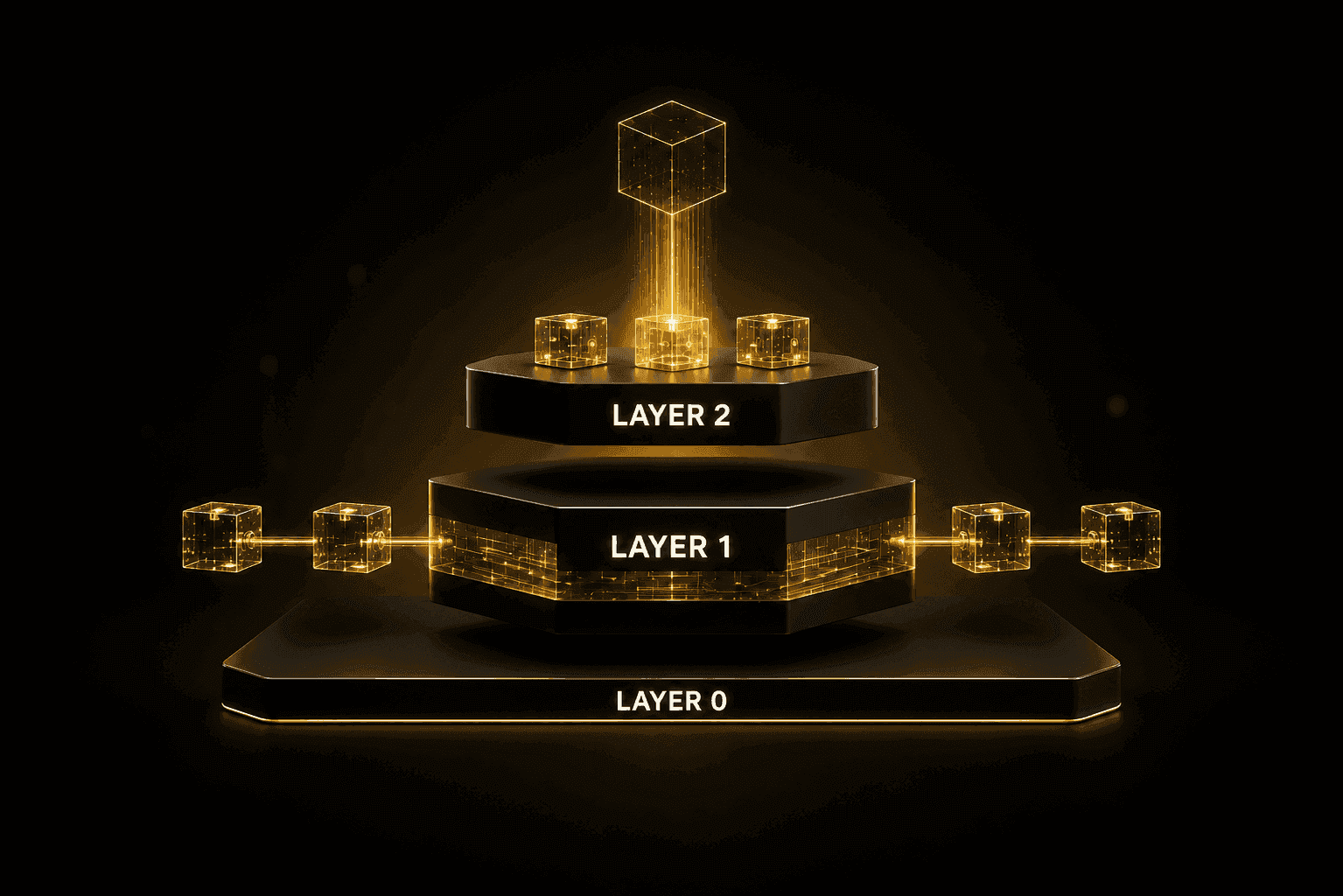
Consensus & execution
OP Stack, Arbitrum Orbit, Cosmos SDK with CometBFT, or Avalanche Subnet-EVM — we pick the stack whose opinions fit the product, not the trendiest one.
Development · Blockchain Layers
Custom blockchain layers built when a sovereign chain is genuinely the right answer. App-chains, rollups, subnets — not sovereign-for-the-sake-of-it.
Corum8 builds custom blockchain layers — application-specific chains, L2 rollups, L3 super-rollups, Avalanche subnets, Cosmos SDK chains and permissioned enterprise networks. Work spans consensus and execution engineering, bridge infrastructure, validator and sequencer operations, and the developer tooling teams need to build on the chain post-launch.
What's included
OP Stack, Arbitrum Orbit, Cosmos SDK with CometBFT, or Avalanche Subnet-EVM — we pick the stack whose opinions fit the product, not the trendiest one.
Canonical L1↔L2 bridges plus LayerZero, Wormhole, Axelar and CCTP for broader interoperability — audit time invested proportional to the TVL crossing.
Ethereum blobs, Celestia, EigenDA or Avail selected on economic model and security assumptions, not preference.
Observability, failover and MEV management designed in from day one, with a path to decentralized sequencing when the chain is ready.
Block explorers, RPC infrastructure, verifier deployment, faucets and Foundry/Hardhat configuration — without it, a chain is a ghost network.
Staking economics, delegation frameworks and slashing rules, with geographic and operator diversity that's real, not performative.
Pay fees in any token, sponsored-gas accounts, free transactions for whitelisted contracts — UX advantages shared infrastructure can't offer.
Validator recruitment, launch-partner app onboarding and bridge integrations that turn a new chain into a used one.
Is this you?
You don't need all of them. One is usually enough to justify the call.
Pay in stablecoin, zero fees for specific users — UX shared L2s genuinely can't offer.
Only approved addresses can deploy, transact or validate — a real requirement, not a preference.
Your needs are high enough to saturate a shared sequencer at current economics.
A domain-specific VM, custom opcodes or privacy-preserving execution that public chains don't support.
Commitments from apps, users and capital to live on your chain from day one — not a hope.
Fully permissioned validator sets or transaction-level censorship controls that public chains can't express.
Sectors
Each layer type suits a different set of product requirements.

OP Stack, Arbitrum Orbit and Polygon CDK deployments — most 'custom chain' projects in 2026.
Settle to an L2 for tighter gas abstraction and throughput customization.

Independent validator sets with custom VMs for permissioned deployments.

Full sovereignty, non-EVM execution and IBC interoperability.

Hyperledger Besu, Canton Network and Quorum for institutional products.

Near-zero fees and custom gas tokens for real-time gameplay.

Permissioned sequencers and reporting hooks for issuance.

Named validator sets and sovereign fee economics for institutional finance.
Process
Two weeks testing whether an existing L2 actually meets the requirements before committing to a custom chain.
Consensus, execution, bridges and DA chosen to fit the product, not the trend.
At least eight weeks on testnet with real apps, bridges and validators before mainnet.
Mainnet with sequencer failover, monitoring and validator onboarding already running.
Case studies
Two chains, two different reasons to go sovereign — institutional settlement and enterprise supply-chain coordination.
A sovereign L1 for an institutional settlement protocol needed sovereign fee economics, a permissioned validator set and on-chain privacy for certain transactions. Built on Cosmos SDK with a custom permissioning module and CometBFT-governed validator set, shipped with 12 named institutional validators and native IBC integration.
A permissioned Avalanche subnet for enterprise supply-chain coordination needed transaction-level privacy and no retail access. Built on Subnet-EVM with custom precompiles for document-hash attestation and cross-enterprise messaging via Avalanche ICM, now running production load across eight participants.
Why Corum8
Through the rollup era and into the 2026 modular-DA era — the discipline was shaped by watching chains fail on ops, not consensus.
Consensus, bridges, sequencer operations, validator design and developer tooling under one roof and one launch calendar.
The first two weeks test whether an existing L2 actually solves the problem — most teams shouldn't build a custom chain.
At least eight weeks of real external participation before any chain of ours reaches mainnet.
Audit investment scales with what's actually crossing the bridge, not a flat checklist.
Validator recruitment, launch-partner onboarding and PR that positions a new chain credibly in a crowded category.
What drives scope
Building a chain is a capital-intensive, multi-year commitment — these factors shape it most.
An L2 rollup on OP Stack or Orbit is lightest and most common in 2026; a sovereign Cosmos SDK chain with an independent validator program is heavier.
A stock rollup deployment with a canonical bridge is light; custom precompiles or consensus modifications each add engineering and audit surface.
Canonical bridges come with the stack; additional general-purpose bridges add integration work, and a fully custom bridge is a security engagement of its own.
Ethereum blobs versus Celestia, EigenDA or Avail affects the economic model and adds a security assumption to audit for each option chosen.
Launching centralized and decentralizing later is cheaper upfront but adds a future migration cost; launching decentralized is more work now.
A bootstrapped L2 needs no validator program; a subnet or sovereign chain needs selection, incentive design and ongoing coordination.
FAQ
Custom blockchain development is the engineering of a new blockchain network — consensus, execution, bridges, developer tooling and operational infrastructure — for cases where existing chains don't meet the product requirements. Most 'custom chain' projects in 2026 are L2 rollups rather than sovereign L1s, because rollups inherit security from Ethereum while still offering meaningful customization.
Most teams should deploy on an existing L2 — custom chains are genuinely right only for gas-abstraction needs, permissioning requirements, unique execution semantics, or throughput that saturates shared sequencers. If your product works on Arbitrum, Base or Optimism, build there and get security, liquidity and ecosystem for free.
Cost is driven by layer type, customization depth, bridge design, data-availability choice, decentralization timeline and validator program scope. A stock OP Stack rollup with a canonical bridge and centralized sequencer is the lightest path; a sovereign Cosmos SDK chain with an independent validator set is an order of magnitude heavier.
Consensus and execution configuration, bridge infrastructure, data-availability integration, sequencer operations, validator program design, RPC infrastructure, block explorer deployment, developer SDK and coordination of third-party security audits sized to the chain's expected TVL. The applications that run on the chain and the tokenomics of any native token sit outside the build scope.
OP Stack is the default for most 2026 L2 projects given its ecosystem size and Superchain interop; Arbitrum Orbit fits when Arbitrum-specific features matter, and Polygon CDK or zkSync Stack fit when zero-knowledge properties are the point. The choice depends on where your users and apps already are, not on a raw technical comparison.
Through canonical bridges that ship with each rollup stack plus mature general-purpose bridges like LayerZero, Wormhole, Axelar and CCTP for broader interoperability — custom bridges are avoided where possible. Bridge security is chain security, so audit time scales with the TVL expected to cross, with independent reviews from bridge-focused audit firms before mainnet.
Yes — permissioned Avalanche subnets, access-controlled OP Stack rollups, and Hyperledger Besu or Canton Network deployments are all in scope. The core engineering shape is similar to a public chain, but the permissioning module, validator recruitment and reporting layer differ substantially.
By economic model and security tolerance, not preference — Ethereum blobs are the most secure and most expensive option, while Celestia, EigenDA and Avail trade some security assumptions for lower cost. Each additional DA option chosen is another security assumption that needs its own audit attention.
Every chain we build spends at least eight weeks on testnet with real external participation — apps deploying, bridges integrating, validators running nodes — before mainnet is even considered. A chain's credibility gets built in that testnet phase or not at all; we don't shortcut it regardless of launch pressure.
Your own chain is the right call when the thing making you different lives at the protocol layer. Custom fee economics, a named validator set, a specific privacy model, block times an existing network cannot give you — those genuinely need their own chain. Where an existing L2 already does what you need, deploying there gets you to users far sooner and you keep the option to migrate later. We will map your requirements against both paths honestly, and the answer is usually clear once the list is on the table.