

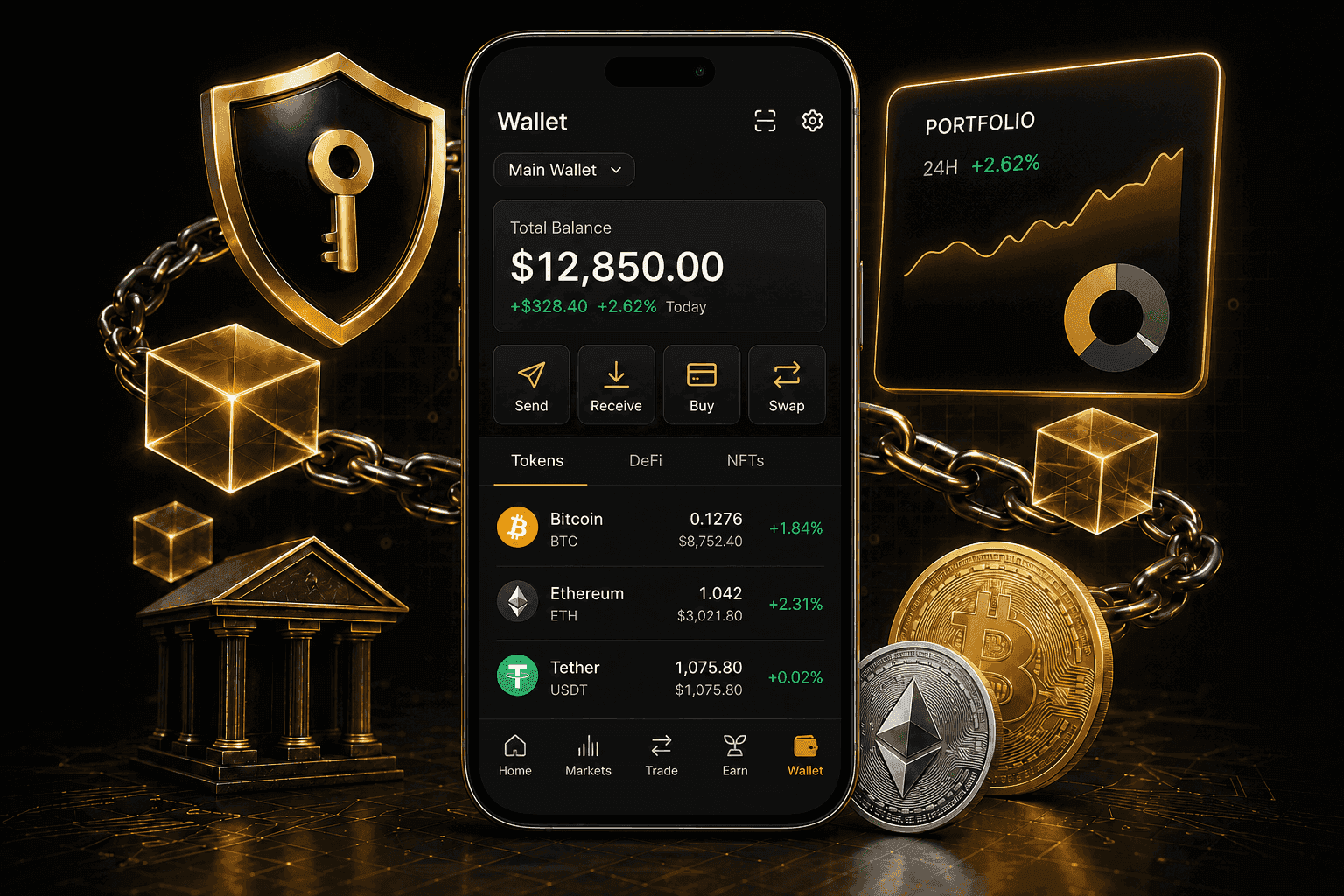
Key management
HSMs for custodial, secure enclaves for mobile, threshold-signature schemes for MPC — each built to be reviewable by the firm you appoint.
Development · Wallets
Wallet infrastructure built to hold real value, not a demo balance. Custodial, non-custodial and MPC — architected so custody failure isn't a risk you accept, it's a scenario you've already designed out.
Corum8 builds production-grade wallet infrastructure — MPC, custodial, non-custodial and hybrid. The work spans key generation, multi-chain transaction signing, hot/cold segregation, threshold signatures, recovery and social-recovery flows, and the admin surfaces security teams actually use.
What's included
HSMs for custodial, secure enclaves for mobile, threshold-signature schemes for MPC — each built to be reviewable by the firm you appoint.
Bitcoin, Ethereum, Solana, TON, Tron and the major L2s abstracted into one chain-agnostic layer that never hides what matters for security.
Automated rebalancing daemons that keep hot-wallet exposure under policy, with explicit approval steps and anomaly alerts.
ERC-4337 account abstraction and guardian-based recovery so users can regain access without ever writing down a 24-word mnemonic.
Preview the actual state change before signing, with phishing detection and explicit confirmation for destructive actions like infinite allowances.
Freeze accounts, flag suspicious transactions and export a complete decision record without engineering support.
Custom MPC or smart-contract-wallet code never reaches mainnet without at least one independent audit, run in parallel with our own security review.
RPC redundancy and transaction-success monitoring per chain, so degraded experiences show up before they hit support tickets.
Is this you?
You don't need all of them. One is usually enough to justify the call.
You're running a custodial product and the white-label wallet provider's roadmap doesn't include something you need next quarter.
Your own reviewers want a decision record that vendor APIs simply can't produce end-to-end.
You're holding eight figures in customer assets, and custody-vendor fees at that scale are now higher than building it yourself.
You need chain coverage or UX patterns that require direct control of the signing layer.
An account-abstraction wallet, a social-recovery product, a wallet-as-a-platform — not a standard integration.
Risks keep surfacing because you don't own the full stack, not because of any one bug.
Sectors
One shared discipline across all of them — key management is never an afterthought.

Custodial infrastructure holding user funds at real scale.
MPC wallets for family offices and asset managers.

Custody with full signing policy and a complete record of every approval.

Non-custodial wallets with recovery flows real users can complete.

Embedded signing layers integrated directly into protocol UX.

Wallet-as-a-platform for consumer audiences that don't hold crypto yet.

Agentic signing flows with explicit human-in-the-loop confirmation.

Distribution wallets built for launch-day volume and scrutiny.
Process
Two weeks enumerating who might attack the wallet and what each attack costs in recoverable versus unrecoverable loss.
Key management, chain integration and recovery flows engineered against the threat model, not a generic checklist.
Independent cryptography review for any custom MPC or smart-contract-wallet code, run alongside our own security review.
Per-chain monitoring, anomaly alerts and an onboarding pipeline ready before the first real user deposits.
Case studies
An institutional MPC rebuild and a retail social-recovery wallet, each engineered around a threat model that had already burned the client once.
An institutional MPC wallet serving family offices had a prior vendor whose threshold-signature protocol deadlocked under partial network partition. We rebuilt it around a CMP-based MPC scheme with explicit ceremony timeouts and automatic recovery, and coordinated independent third-party review of the new signing path before it went live.
A retail multi-chain wallet aimed at first-time crypto users needed to feel like a normal fintech app, not a Web3 tool, with recovery UX people could actually complete. An ERC-4337 account-abstraction wallet with guardian-based recovery and four integrated regional on-ramps came through recovery testing without a single unrecoverable account.
Why Corum8
The lessons of QuadrigaCX, Celsius and FTX-era custody failures directly shape how we design custody architecture today.
Cryptography, chain integration, HSM infrastructure, onboarding and client surfaces under one roof and one security lead.
Independent audit and our own security review both have to clear before any custody code touches real funds.
A single engineer is never the only one who understands a wallet's most critical code paths.
The reporting-facing audit trail is part of the architecture from day one, not a scheduled CSV export bolted on later.
Self-custody education, PR that positions the custody model correctly, and marketing that clears jurisdictional friction.
What drives scope
The decisions that move cost by 10x on a wallet build happen in the first two weeks.
Each category carries different HSM and custody costs — MPC is the most capital-efficient long-term and the most audit-intensive short-term.
Five chains is one build; twenty chains is a fundamentally different one, with address validation and fee estimation multiplying per chain.
Integrating a vendor like Fireblocks or BitGo is faster; building a custom HSM-backed MPC stack is more capital-efficient at scale but needs real cryptography engineering.
A plain 24-word mnemonic is cheapest; social recovery via ERC-4337 or Argent-style guardians adds complexity but cuts user-loss rates substantially.
A single-market wallet is a very different onboarding pipeline from a product operating across several markets at once.
A standalone consumer wallet, an embedded exchange wallet, and wallet-as-a-service for other fintechs each carry different API and support costs.
FAQ
Crypto wallet development is the engineering behind any software surface where users hold, move or authorize transactions of digital assets — spanning custodial, non-custodial and MPC models. Real builds also include multi-chain signing, HSM or secure-enclave key storage, hot/cold segregation, social-recovery flows, transaction simulation and operations tooling, not just a signing interface.
Cost is driven mostly by custody model, chain coverage, HSM and MPC choices, market scope and recovery model — not the client UI, which is what most teams focus on first. A single-chain non-custodial wallet is an order of magnitude lighter than a multi-chain MPC wallet with institutional controls throughout.
It depends on who holds the liability and who the product serves — custodial fits exchanges and institutional products, non-custodial fits DeFi-native audiences, and MPC is where most institutional and hybrid products have landed in 2026. MPC lets the operator carry operational control without ever holding a full key, which gives institutions the oversight they want without concentrating the risk of pure custody.
Key management, multi-chain transaction signing, hot/cold segregation for custodial products, recovery flows including social recovery, transaction simulation, phishing detection, admin and operations surfaces, and the client applications themselves. Anything legal, and the HSM hardware procurement, sit outside the engineering scope — we integrate the identity partners and specify hardware, but the filing and the purchasing are yours.
Through threat modeling before code, adversarial review during the build, and independent audit before mainnet. Custom cryptography — any custom MPC or threshold-signature code — gets at least one independent audit before touching production funds, with continuous anomaly monitoring and periodic red-team exercises after launch.
More than most teams expect, which is why you want your counsel's answer before the architecture, not after it. What they tell you drives the key management, the signing policy, the fund-segregation model and the onboarding flow — all of which are extremely expensive to change once a wallet holds real balances. Custodial products carry the heaviest requirements because you are holding someone else's money. Non-custodial wallets start lighter, though that changes the moment you add fiat on and off ramps. We do not advise on any of it. We build to what you bring us.
Both — third-party custody integration is often fastest for institutional products moving off spreadsheet custody, while custom builds make sense when you need every signing decision inspectable end-to-end, or when vendor costs at scale exceed the cost of building. We run the math with you before recommending either path.
Through social recovery mechanisms — passkeys, hardware-device attestation and trusted-contact guardians via ERC-4337 or similar account abstraction — designed so recovery feels like resetting a password, not retrieving a 24-word mnemonic. A recovery flow nobody can complete during a real panic is worse than having none at all.
Bitcoin, Ethereum, Solana, TON, Tron and the major EVM L2s at minimum, abstracted into a chain-agnostic transaction layer that still surfaces the chain-specific details that matter for security. Additional chains get added based on product need, each with its own address validation, fee model and RPC redundancy built in.
Your own wallet earns its place when the key experience is part of what makes the product good. Custom recovery, specific signing policy, deep protocol integration, an onboarding flow that hides the seed phrase entirely — those need building. Where a standard connect-and-sign flow serves your users well, an embedded provider gets you shipping far sooner. Plenty of products start embedded and build their own once the wallet becomes central. We scope against what your users actually need from key management.