

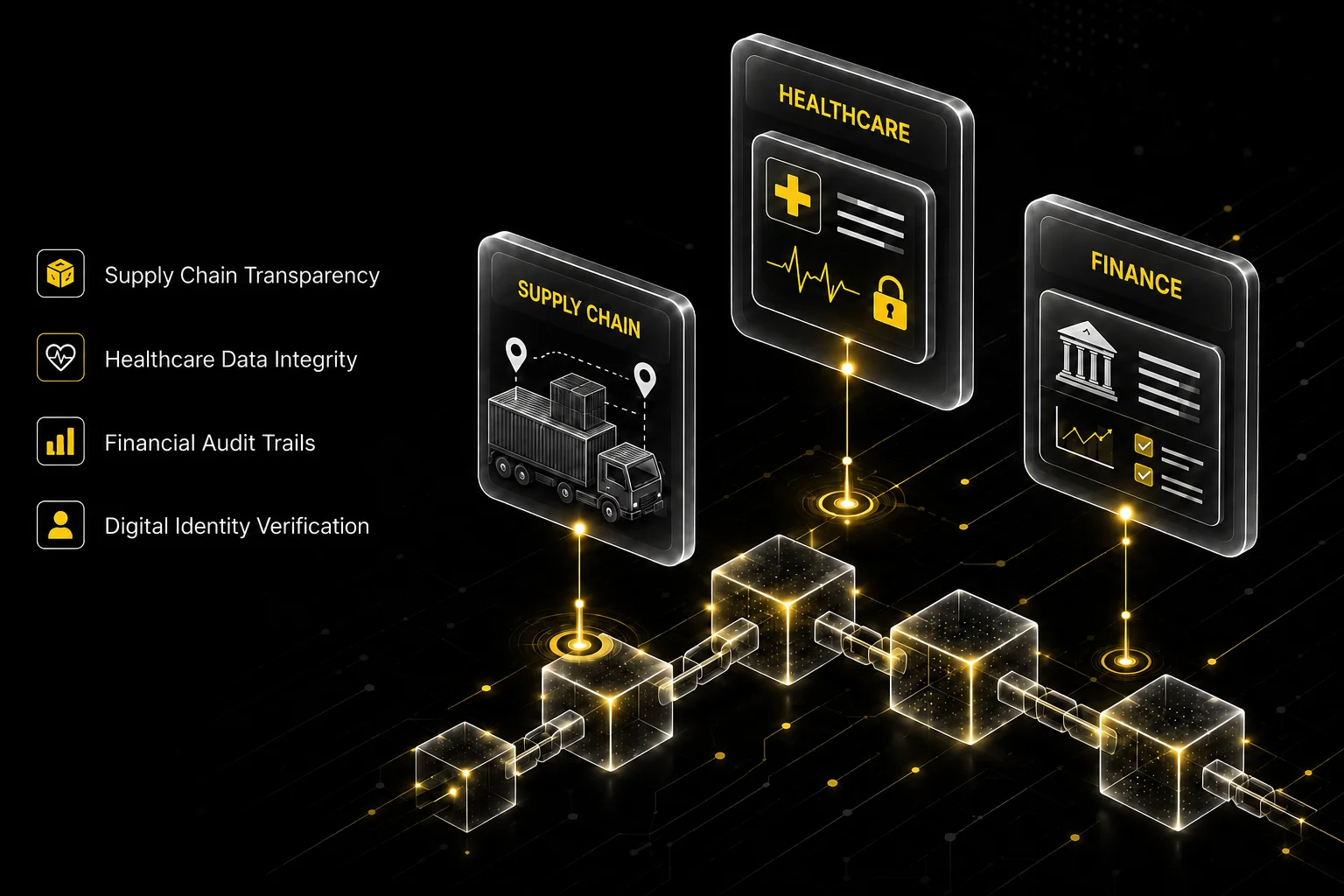
Permissioned & consortium chain architecture
Private and consortium chain design for institutions that need control over participants, not public-chain openness.
Development · Enterprise Blockchain
Enterprise blockchain built to survive security review, not just a pilot demo. Permissioned chains, institutional tokenization pilots and legacy-system integration — engineered for the pilot-to-production path most projects never complete.
Corum8 builds permissioned and consortium blockchain systems, institutional tokenization pilots and the legacy-system integration work that gets an enterprise blockchain project from pilot to production. Work spans access control, encryption and key management designed in from the start, supply chain traceability, trade finance settlement and the multi-stakeholder governance design that consortium blockchains actually need to function.
What's included
Private and consortium chain design for institutions that need control over participants, not public-chain openness.
Blockchain systems wired into existing enterprise infrastructure, not deployed alongside it as an island.
Pilot-scoped tokenization programs built for real institutional risk tolerance, not a startup-style proof of concept.
Access control, encryption, key management and a full change record built in from the first sprint, not retrofitted under deadline pressure.
Provenance and traceability systems that hold up to audit, across multi-party supply chains with real stakeholder friction.
Verifiable credential systems for institutional identity, access and permissioning use cases.
Consortium governance design for the multi-party decision-making a shared enterprise chain actually requires.
The scaling path planned from the pilot stage, so a successful pilot doesn't stall for lack of a production plan.
Is this you?
You don't need all of them. One is usually enough to justify the call.
You need a blockchain pilot scoped for institutional constraints, not a startup-style demo dressed up as enterprise-ready.
Your data or your competitive position means the chain needs to be permissioned, and your current plan doesn't reflect that.
Leadership wants to explore tokenization, but nobody has scoped what it would actually take to build.
Provenance claims currently rely on trusting individual parties instead of a verifiable, auditable record.
The blockchain concept is sound, but nobody has solved how it connects to your existing enterprise systems.
A pilot proved the concept, but there's no scoped plan for what production deployment actually requires.
Sectors
The institution differs, the security discipline doesn't.

Multi-party chains with controlled participation and shared governance.

Provenance systems that hold up across multi-party supply chains.

Pilot-scoped tokenization for real institutional risk tolerance.
Bank-grade blockchain infrastructure built for security review.

Public-sector blockchain programs built to survive a procurement process.

Multi-party settlement systems replacing slow paper-based trade finance.

Verifiable credential systems for institutional access and permissioning.

Legacy-system integration that connects blockchain to existing infrastructure.
Process
Security review requirements and institutional risk tolerance mapped before any architecture decision.
Chain architecture and legacy integration engineered against the control requirements your security team sets, from the first sprint.
Multi-party testing and governance validation before the pilot goes live with real participants.
The production scaling path gets planned during the pilot, not discovered as a gap after it succeeds.
Case studies
A consortium supply chain pilot and a permissioned tokenization platform.
A supply chain consortium's traceability pilot needed to prove real value with three initial participants before other firms would commit. Building governance and onboarding designed for easy participant addition from day one let the network scale to twelve participating firms within a year without re-architecting the core system.
A financial institution's tokenization pilot needed to clear an internal security review process that had stalled two prior blockchain initiatives. Architecting the pilot around the control requirements their security team set, from the design stage rather than retrofitting them before review, cleared the security review on first submission.
Why Corum8
Pilots are built against real security review and risk-tolerance constraints, not a generic startup demo.
Access control, encryption and a complete change record from the first sprint, because retrofitting them later means rewriting the parts that matter most.
Blockchain systems wired into existing enterprise infrastructure, not deployed as a disconnected island.
Multi-stakeholder governance built for the actual decision-making a shared enterprise chain requires.
The production scaling plan gets built during the pilot, so success doesn't stall for lack of a next step.
1,100+ projects and operations across 30+ countries — enterprise delivery discipline, not startup improvisation.
What drives scope
Cost is driven by chain type, integration complexity and stakeholder count.
A scoped pilot is lighter than a full production deployment across an institution's existing operational footprint.
Permissioned and consortium chains add governance and access-control engineering public chains don't need.
Internal-only pilots are lighter. Architecture that has to satisfy your security team for sensitive data adds real engineering scope.
A standalone system is simpler than one integrated into an institution's existing legacy infrastructure.
A single-institution system is simplest. Multi-party consortium governance needs coordinated design across every participant.
Financial services, government and healthcare each hand you a different list of requirements, and each list shapes the architecture differently.
FAQ
Enterprise blockchain development is the engineering of permissioned and consortium blockchain systems, institutional tokenization pilots and the legacy-system integration that connects blockchain to existing enterprise infrastructure. The discipline centers on control design and multi-stakeholder governance, since enterprise blockchain projects have to clear security review and coordinate real institutional participants, not just work in a demo.
Cost is driven by pilot-versus-production scope, permissioned-versus-public chain choice, control depth, integration complexity, stakeholder count and the requirements your industry hands you. A scoped internal pilot is a different budget than a multi-institution consortium chain integrated into existing legacy systems with a full control layer.
Permissioned or consortium chains fit when participant control or data privacy demand it — which is most enterprise use cases; public chains fit when open participation and permissionless access are genuinely part of the value proposition. Most institutional pilots start permissioned, since it matches the participant-control requirements enterprises actually operate under.
By scoping the production path during the pilot itself — the infrastructure, governance and integration requirements for production scale get planned from day one, not discovered as a gap after the pilot proves the concept. Pilots that stall commonly do so because production requirements were never scoped alongside the pilot.
Chain architecture (permissioned or consortium), legacy-system integration, security architecture built to your control requirements, governance design for multi-stakeholder participants, smart contract development, and a scoped production scaling path. Legal sign-off stays entirely with your institution's counsel, informed by our technical architecture documentation.
Yes — provenance and traceability systems that hold up to audit across multi-party supply chains are a core practice area, engineered so no single participant needs to be trusted for the record to be verifiable. This requires governance design across every participating party, not just the technical traceability layer.
Yes — RFP response support and security-review preparation are part of the practice, since enterprise blockchain pilots typically move through the same procurement and security scrutiny as any other enterprise technology purchase. The technical architecture and the procurement response get built together, not treated as separate workstreams.
A pilot succeeds when several parties genuinely need to share a record none of them controls alone. Supply-chain traceability across suppliers, trade-finance settlement between counterparties, multi-party reconciliation — those are the cases where the technology earns its place and the results show quickly. Where a shared database between two cooperating teams would do the same job, we will tell you. The pilots that go furthest are scoped narrow, with real participants and a measurable before-and-after, rather than broad demonstrations that never leave the lab.