

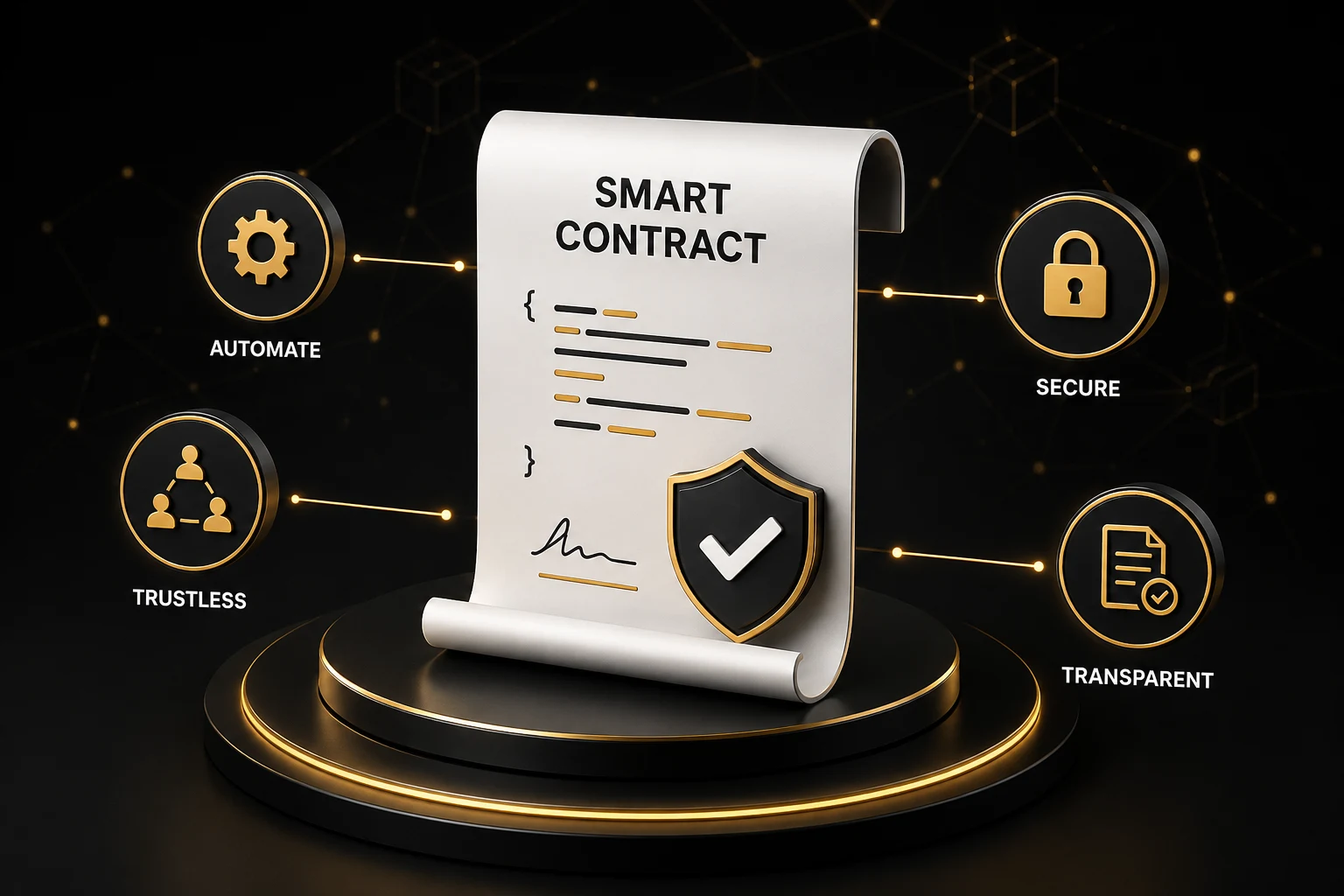
Contract architecture & design
Minimal contracts by default — every extension beyond the core logic adds audit surface and failure modes.
Development · Smart Contracts
Contracts built to hold value safely, not just to look clever in a demo. Solidity, Rust and Move engineering — minimal, audited, gas-efficient contracts that survive real usage.
Corum8 builds and audits smart contracts across Solidity, Rust and Move — architecture, gas optimization, upgradability design, testing and coordinated third-party audits for contracts that hold real value. Every deployment handling meaningful TVL goes through two independent third-party audits as a minimum, run by firms you engage directly.
What's included
Minimal contracts by default — every extension beyond the core logic adds audit surface and failure modes.
Storage layout, loop structure and call patterns tuned for real transaction costs, not just correctness.
Transparent, UUPS or diamond proxy patterns chosen deliberately, with the tradeoffs of each made explicit.
Unit, integration and fuzz testing, plus mainnet-fork simulation against realistic transaction sequences.
Mathematical proof of core invariants for the components where a bug would be catastrophic.
Solidity for EVM chains, Rust for Solana, Move for Aptos and Sui — matched to where your users actually are.
We book and manage the calendar with two independent tier-one firms, plus bug-bounty programs at mainnet for material TVL.
On-chain monitoring and incident runbooks for the moment something behaves unexpectedly in production.
Is this you?
You don't need all of them. One is usually enough to justify the call.
The contract is close to deployment and handles user funds, but no independent security review has happened yet.
Transaction costs on your current contract are high enough that users are abandoning transactions.
A bug or new feature needs shipping, but your current contract has no upgradability built in.
You've had a security review come back with findings and need them properly remediated, not patched over.
The same logic needs to run on a chain with a different language and execution model than your first deployment.
Something already went wrong, or almost did, and the contract needs a serious security-first rebuild.
Sectors
The logic differs, the security discipline doesn't.

Lending, staking and AMM logic with invariants enforced on every state change.

ERC-20, SPL and equivalent standards with minimal, audit-clean extensions.

Minting, royalty and marketplace logic built for gas efficiency at scale.

Voting, timelock and treasury logic that actually controls what it claims to.
Time-locked vesting and multisig-controlled treasury logic with clear audit trails.

Message-passing and asset-bridging logic engineered against the highest-risk attack surface in crypto.

Game-state and reward contracts built for high transaction volume.

Transfer restrictions enforced on-chain for permissioned, tokenized instruments.
Process
Attack vectors and adversarial scenarios mapped before a line of Solidity, Rust or Move gets written.
Contracts engineered against the threat model, with unit, integration and fuzz testing throughout.
Two independent third-party audits minimum, with every finding remediated and re-reviewed before deployment.
Multisig-executed, documented deployment with on-chain monitoring live from day one.
Case studies
A lending protocol audit-readiness rebuild and a cross-chain bridge built to the highest assurance bar in the category.
A lending protocol's original contracts had accumulated ad-hoc modifications to the point where reviewing them cleanly had become impractical. We rebuilt the core logic around minimal, well-tested primitives rather than patching the existing code, then coordinated the review calendar with two independent firms so remediation and re-review both happened before mainnet.
A cross-chain bridge needed the highest possible assurance on its message-passing and settlement logic, given that bridge exploits are among the most costly incidents in the industry. Formal verification on the core settlement invariants, alongside two independent third-party audits, gave the team a level of assurance beyond standard review coverage alone.
Why Corum8
Every extension beyond core logic gets scrutinized for the audit surface and failure modes it adds.
No mainnet deployment without at least two independent third-party audits from tier-one firms.
Solidity, Rust and Move engineering under one roof, matched to where your users actually are.
Mathematical proof of core invariants for the components where a bug would be catastrophic.
A track record shaped by watching what actually fails in production, not just theorizing about security.
On-chain monitoring and incident runbooks that stay live long after deployment day.
What drives scope
Cost is driven by contract complexity, chain choice and audit depth — not lines of code.
A single-purpose token contract is lightest. Multi-contract systems with cross-contract state are materially heavier.
EVM/Solidity work is the most standardized. Solana/Rust and Move-based chains carry different tooling maturity.
One audit is baseline for low-TVL contracts. Two audits plus formal verification is standard once real capital is at stake.
Immutable contracts are simplest to audit. Proxy-based upgradability adds real architectural and security complexity.
A standalone contract is simpler than one integrating with external oracles, bridges or other protocols.
Standard unit testing is one scope. Fuzz testing and mainnet-fork simulation against adversarial scenarios is more.
FAQ
Smart contract development is the engineering, testing and security review of self-executing code deployed on a blockchain — covering architecture, gas optimization, upgradability design, testing and coordinated third-party audits. The discipline centers on minimizing attack surface, since a smart contract handling real value is effectively immutable, high-stakes financial infrastructure the moment it deploys.
Cost is driven by contract complexity, chain and language choice, audit depth, upgradability requirements, integration surface and testing rigor — not lines of code. A single-purpose token contract is a different budget than a multi-contract DeFi system with external oracle integrations and formal verification requirements.
Two independent third-party audits from tier-one firms is the standard baseline for any contract holding meaningful value; formal verification on the most critical components is increasingly expected for high-TVL protocols. The right depth scales with how much capital the contract will hold and how catastrophic a failure would be.
It depends entirely on which chain your users are on, not a technology preference. Solidity for Ethereum and EVM-compatible L2s, Rust for Solana, Move for Aptos and Sui. Most teams building for a single primary chain need one language; multi-chain products need engineers fluent in more than one.
Threat modeling, contract architecture and implementation, unit and fuzz testing, coordination of two independent third-party audits, remediation of their findings, deployment and verification, and post-deployment monitoring. Bug-bounty program setup is standard for contracts with material TVL at mainnet.
Yes — remediating findings from a prior audit, and getting the fix independently re-reviewed, is a common and important part of the practice. A finding that gets patched without a follow-up review is a common source of contracts that pass an audit on paper but remain vulnerable in practice.
Yes — including designing an upgrade path for contracts that launched immutable and now need one, and migrating state to a new contract version where an upgrade path was never built in. Both require careful handling of existing user funds and state, which is a different risk profile than a fresh deployment.
Start from a battle-tested standard wherever one fits, and write custom code only where your logic genuinely differs. OpenZeppelin implementations of ERC-20, ERC-721 and ERC-1155 have been reviewed more times than anything we could write from scratch, and using them is simply better engineering. Custom earns its place in the parts that are actually yours — the distribution rules, the transfer restrictions, the settlement logic. Minimal custom surface on top of proven foundations is the cheapest contract to audit and the safest to run.