

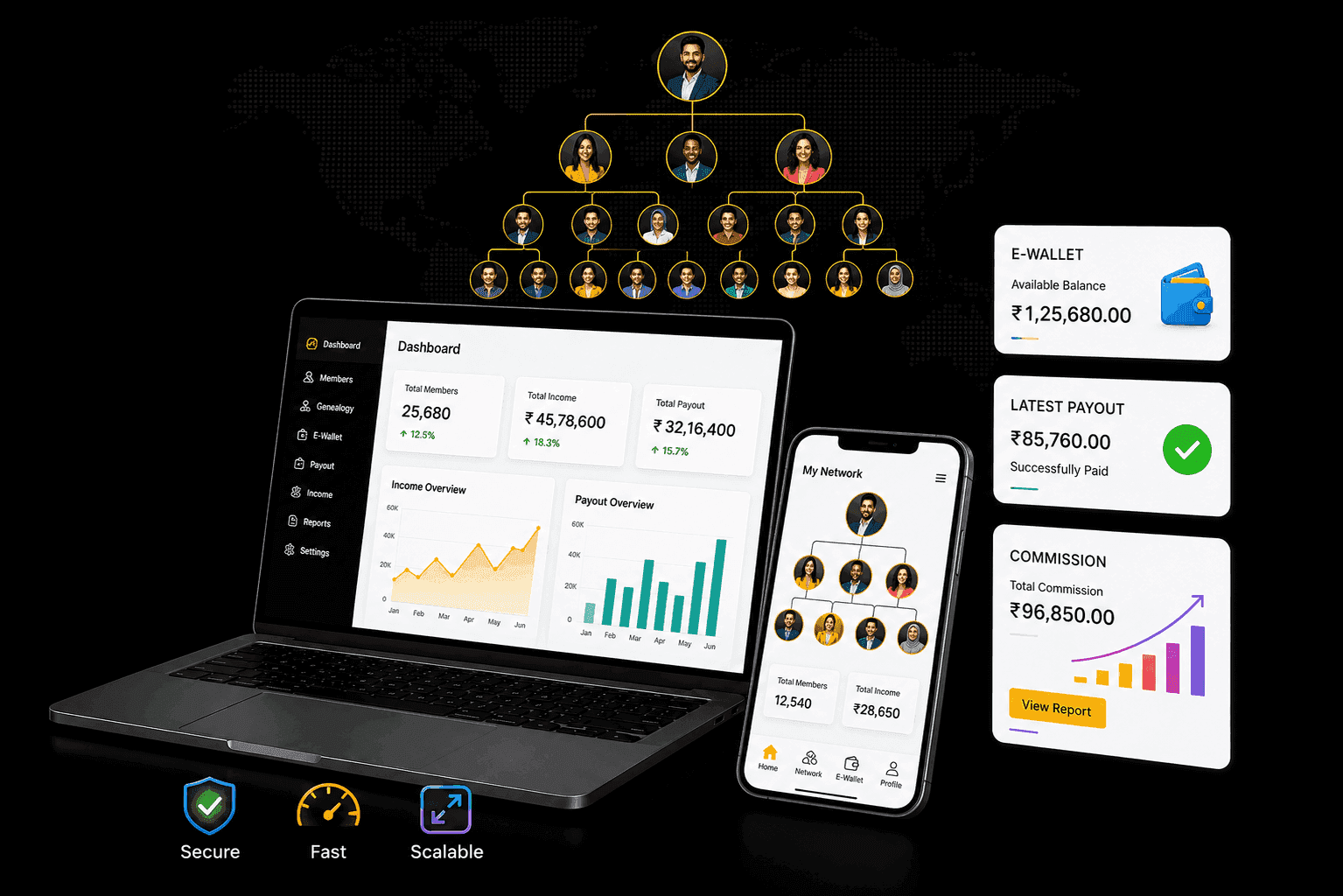
Compensation plan engineering
Unilevel, binary, matrix or hybrid plans modeled for sustainability before a single commission gets calculated.
Development · Referral & Affiliate
1,100+ projects delivered since 2016. Multi-tier commission calculation, referral tracking and distributor portals — engineered so the payout numbers hold up under scrutiny.
Corum8 builds referral, affiliate and multi-tier compensation platforms — commission calculation engines, distributor management portals and payout automation. Work centers on getting the arithmetic right at scale: modelling the plan your team and your counsel have designed, then building calculation logic that produces the same answer every time across thousands of distributors and millions of transactions.
What's included
Unilevel, binary, matrix or hybrid plans modeled for sustainability before a single commission gets calculated.
Accurate, auditable commission math across every tier, run automatically instead of reconstructed by hand.
Referral chains tracked reliably from first click through to a completed, verified sale.
Self-serve dashboards where reps see their downline, earnings and real-time performance.
Scheduled payouts across bank transfer, card or stablecoin rails, without a manual reconciliation step.
We model the plan your team designed and show you what it actually pays out at scale, before a line of calculation logic is written.
Genealogy trees and performance reporting that make the actual network structure legible.
Detection for the self-referral and fake-account patterns that inflate payouts without real sales behind them.
Is this you?
You don't need all of them. One is usually enough to justify the call.
Your compensation math is reconstructed by hand or in spreadsheets, and mistakes are reaching real payouts.
You can't confidently say which referral actually drove which sale, and reps are noticing.
Your compensation structure has grown complicated enough that no one can say with confidence what it pays out at scale, or what it costs you.
Distributors are waiting too long for commissions because payout processing isn't automated.
Distributors have to ask support for basic information about their downline and earnings.
Fake accounts or self-referrals are inflating payouts without real product sales behind them.
Sectors
The plan structure differs, the payout accuracy discipline doesn't.

Product-based compensation platforms for established direct-sales companies.

Single-tier referral tracking for SaaS, e-commerce and consumer products.

Unilevel and multi-tier calculation engines built for accuracy at scale.

Structured compensation models with defined width and depth limits.

Referral programs integrated directly into existing checkout flows.

On-chain referral tracking and token-denominated commission payouts.

Plans where commission is calculated off verified product sales.

Self-serve dashboards for network visibility and earnings tracking.
Selected work
Network tree, earnings and payout status — built for a rep checking their downline from a phone, not a spreadsheet.
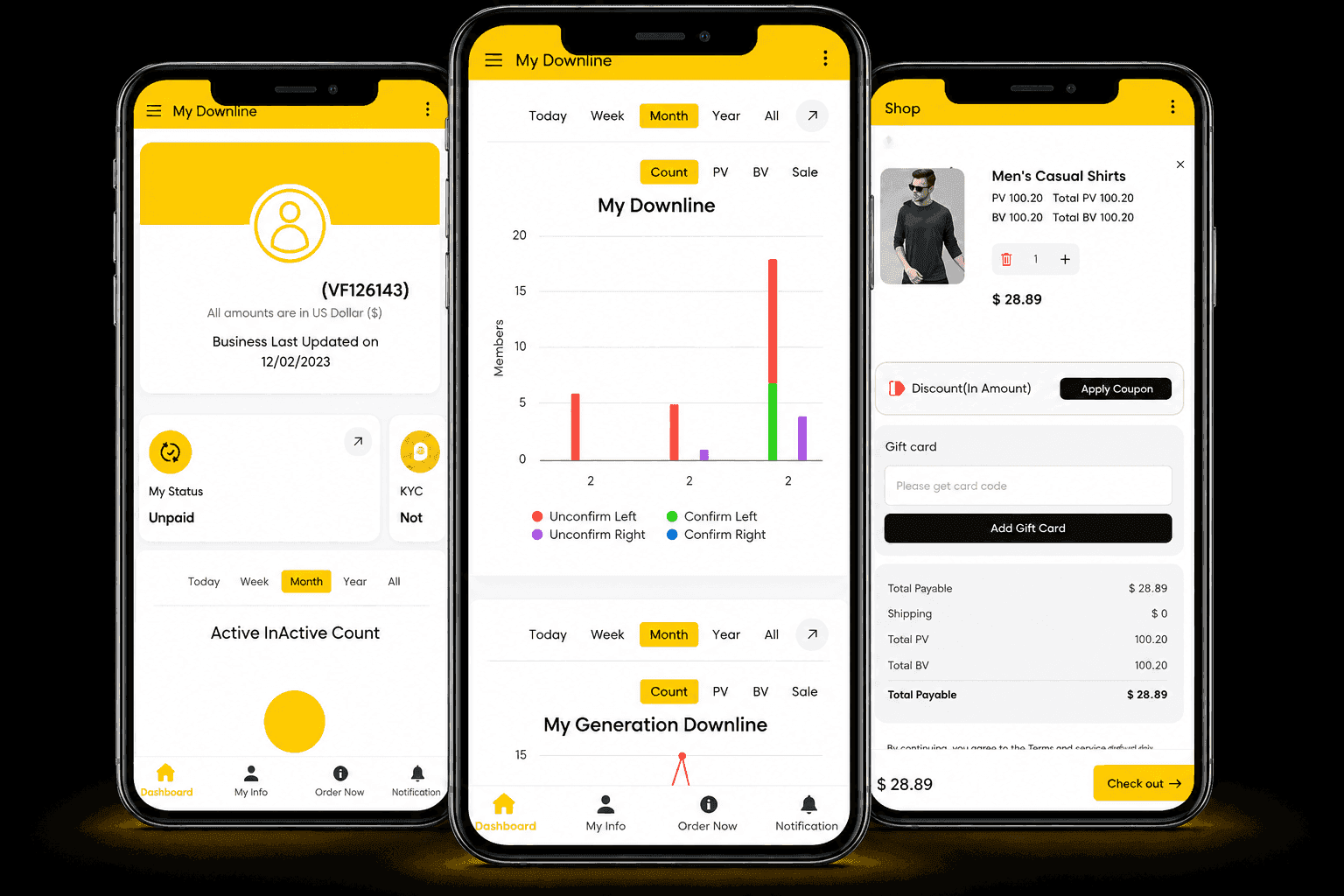
Referral & Affiliate Mobile App
Process
The plan your team and your counsel settled on gets modelled and pressure-tested at scale before any calculation logic gets built.
Referral attribution and commission calculation engineered for accuracy across every tier.
Edge cases, self-referral patterns and payout math tested rigorously before real money moves.
Distributor-facing portal and automated payouts go live together, with monitoring from day one.
Case studies
A direct-sales platform rebuild and a compensation-engine rebuild.
A direct-sales company's legacy platform was producing commission calculation errors that eroded distributor trust and required constant manual correction. Rebuilding the calculation engine around automated, auditable tier logic eliminated the recurring errors and gave distributors confidence in their payout accuracy.
A network marketing company had decided, with its own advisers, to move its compensation off recruitment-based bonuses and onto verified product sales. That is a different calculation entirely, and their existing engine could not express it. We rebuilt the commission logic around sales events, modelled the new plan against historical data so the company could see what it would actually pay before switching, and migrated the distributor base onto it.
Why Corum8
We model what a plan pays out against real volumes before writing the calculation logic, because finding the problem in a spreadsheet is cheaper than finding it in production.
Zero payout-accuracy incidents across our platforms — commission math that distributors can trust.
Self-serve portals that answer the questions your support team currently fields manually.
Self-referral and fake-account patterns get caught before they inflate real payouts.
Bank transfer, card and stablecoin payout rails automated without manual reconciliation.
1,100+ projects and 10+ years engineering the payout math that has to be right every single cycle.
What drives scope
Cost is driven by plan complexity, tier depth and payout rail count.
A single-tier affiliate program is lightest. Multi-tier unilevel or matrix plans with bonuses are materially heavier.
A shallow two-tier structure is simple to calculate. Deep multi-tier structures multiply calculation complexity.
Single-rail bank payout is one scope. Multi-rail automation across bank, card and crypto is more involved.
A single-market plan is lighter than one that has to express different rules, currencies and tax handling per region.
A standalone platform is simpler than one integrated into an existing e-commerce or CRM system.
Basic duplicate-account checks are baseline. Behavioral fraud detection across the network is a bigger system.
FAQ
Referral and affiliate platform development is the engineering of commission calculation engines, referral tracking, distributor portals and payout automation for affiliate programs and multi-tier compensation structures. The discipline centers on payout accuracy at scale — a plan that pays thousands of distributors across millions of transactions has to produce the same answer every time, and reproduce it months later when someone disputes a figure.
No, and you should be wary of any software vendor who says otherwise. Whether a compensation structure is lawful depends on how it is designed and where it operates, and that is a question for your own counsel. We are engineers. What we do is take the plan your team and your advisers have settled on, model it honestly so you can see what it really pays out at scale, and build calculation logic that implements it exactly. If the modelling surfaces something that looks wrong to us, we will say so — but the call is theirs, not ours.
Cost is driven by compensation plan complexity, tier depth, payout method, market count, integration scope and fraud prevention rigor. A single-tier affiliate program is a different budget than a deep multi-tier structure with multi-rail payout automation across several markets. Tier depth is the one that surprises people: each additional level multiplies the calculation work and the number of edge cases that have to be tested.
Yes — re-engineering the calculation layer after a plan change is one of the more common engagements we take. Teams change plans for all sorts of reasons, and the existing engine usually cannot express the new structure without a rewrite. We model the new plan against your historical volumes first, so you can see what it would actually have paid before you commit to it, then rebuild the calculation logic and migrate the distributor base. The plan itself is designed by you and your advisers. We implement it.
Compensation plan modelling, referral tracking and attribution, multi-tier commission calculation, distributor portal, payout automation, network reporting, and fraud detection. Review of the compensation plan itself sits with your own counsel. We model what it pays and build what they approve.
Through behavioral detection — identifying duplicate accounts, self-referral patterns and unusual network-growth signals before they inflate real payouts. Fraud in referral programs tends to follow specific detectable patterns; catching them early protects both the payout budget and the program's credibility with legitimate distributors.
Yes — on-chain referral tracking and token-denominated payouts are part of the practice, giving community members a way to verify their own referral chain and commission independently rather than trusting an opaque backend. This works particularly well for crypto-native communities that value transparency over convenience.
Match the platform to the compensation plan you actually intend to run, not to the one you might run someday. A single-tier referral programme is a genuinely simple build and works well for most products. Deep multi-tier structures, multi-rail payouts and per-market rules are a different class of engineering and worth it when the distribution model is central to the business. We model your plan against real volumes first, so the sophistication you pay for is the sophistication you will use.