

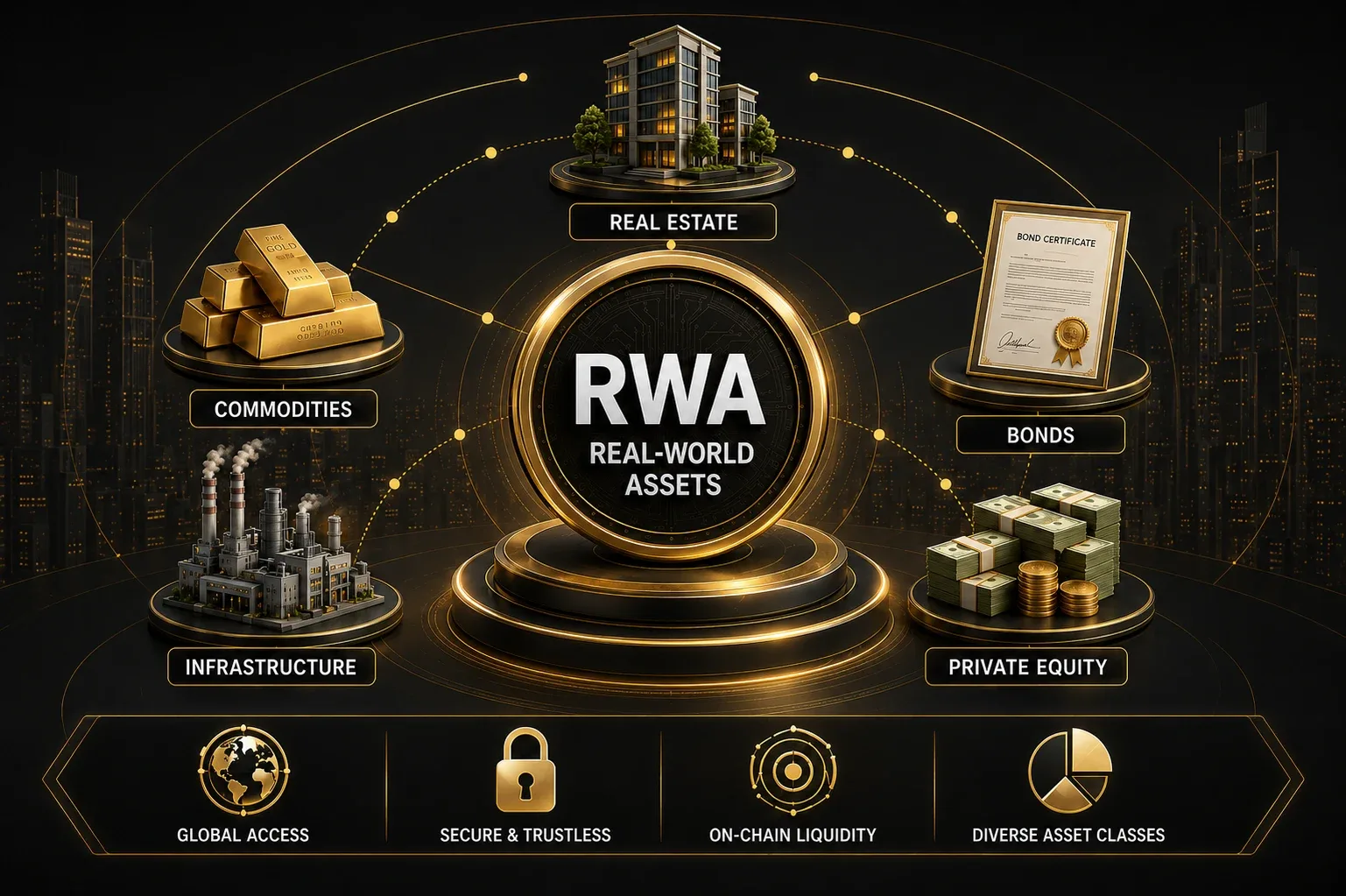
Issuance contracts
Transfer restrictions, whitelists and distribution rules written into the contract exactly as your counsel specifies them.
Development · Real-World Assets
Real-world assets tokenized with the legal wrapper leading the smart contract, not the other way around. Real estate, private credit, funds, infrastructure — on-chain, with the contract matching the paperwork.
Corum8 builds real-world asset tokenization platforms for issuers, fund managers and marketplaces. The work spans asset structuring on-chain, investor onboarding, primary issuance, automated distributions, secondary-market engines, and the reporting surfaces your counsel and your investors ask for.
What's included
Transfer restrictions, whitelists and distribution rules written into the contract exactly as your counsel specifies them.
KYC, KYB, accreditation checks and sanctions screening via Sumsub, Persona or Onfido, with wallet screening through Chainalysis or TRM.
An explicit state machine — pledged, funded, minted, settled — with stablecoin and fiat rails reconciled against the custodian of record.
Pro-rata yield, interest and principal distributions with correct withholding treatment, computed on schedule with auditable events.
Integration with the venues your counsel approves, or internal OTC matching, with delivery-versus-payment settlement reducing counterparty risk.
Per-market reporting exports reconciled against the on-chain state — because pointing an investor at a block explorer is not a report.
At least two independent firms review every RWA smart-contract system before mainnet, and we plan that calendar from week one so it never becomes the thing holding up launch.
Migration paths and multi-chain mirroring so a single-chain outage can't halt distributions to real investors with legal obligations.
Is this you?
You don't need all of them. One is usually enough to justify the call.
You're an asset manager wanting fractional access for investors who can't meet traditional minimums.
You want secondary liquidity for positions that currently live in paper form with quarterly redemption windows.
You're launching a fund with meaningful international distribution and want one token serving investors across jurisdictions.
Your transfer-agent, custody and administration costs exceed the engineering cost of on-chain issuance at the size of fund you are running.
Your base includes tech-forward family offices or crypto-native capital that specifically wants on-chain exposure.
You're issuing against carbon, streaming revenue or trade finance — categories where traditional rails simply don't exist.
Sectors
Each asset category carries its own corporate-action and reporting edge cases.

Fractionalized commercial buildings and residential portfolios.

Direct lending, invoice financing and trade finance with default handling.

Money-market and feeder funds with mark-to-NAV and redemption windows.
Utility and solar-project debt with multi-entity cash-flow distribution.

Gold and carbon-credit issuance with proof-of-reserve oracles.

Revenue-share tokens and SAFEs with programmable terms.
On-chain feeders into traditional asset-manager parent funds.

Offerings that run across several markets at once, each with its own onboarding rules.
Process
Two weeks with the issuer's counsel mapping the SPV structure, transfer restrictions and investor eligibility logic first.
Issuance contracts, KYC integration and the subscription state machine engineered to mirror the offering documents exactly.
We coordinate review by at least two independent third-party firms before mainnet.
Distribution, corporate actions and reporting all run against the same canonical on-chain ledger.
Case studies
A tokenized money-market fund and an infrastructure-debt platform distributing across multiple operating entities.
A tokenized money-market fund feeding an institutional parent product needed a redemption engine that could hold a request queue against an underlying portfolio settling T+1. We built a custom mint/burn engine with Chainlink proof-of-reserve integration, so the on-chain supply and the reported holdings reconcile continuously rather than at month end.
An infrastructure-debt platform for solar and utility projects needed to handle quarterly distributions across multiple operating entities with varying withholding regimes. A multi-tier distribution system pooling project cash flows launched with three infrastructure projects live.
Why Corum8
Most 2019-era security-token products didn't survive — the ones that did had strict alignment between legal wrapper and on-chain enforcement.
Whatever transfer and holder rules your counsel sets, we build them into the contract itself rather than enforcing them off-chain.
Smart contracts, issuance infrastructure, investor flows, onboarding pipeline and reporting under one roof and one security lead.
Engineers who've built waterfalls and distributions in traditional fund admin, not just token contracts.
We do not audit our own work, and we would not ask you to trust an audit from the people who wrote the code. Where you want independent review we bring in specialist firms and schedule them into the build — quoted and billed separately, on top of the engagement.
Institutional-grade communications and carefully written PR that help serious capital clear the trust barrier on a new instrument.
What drives scope
The decisions that move cost by 5-10x happen before a single contract gets written.
Real estate, private credit and a tokenized money-market fund are three different builds with category-specific corporate-action and tax edge cases.
Different structures need different onboarding flows and different transfer-restriction logic in the contract.
Institutional-only, retail and global offerings each need different onboarding flows and whitelist rules.
Issuance alone is lighter scope; adding a secondary matching engine is significantly more work.
Ethereum for institutional credibility, Polygon or Arbitrum for cost, Avalanche subnets for permissioned institutional deployments.
Deep integration with a traditional custodian adds real engineering time; running your own custody is lighter to build but heavier to operate.
FAQ
RWA tokenization is the process of representing ownership of a real-world asset — property, private credit, a fund, infrastructure — as a token on a blockchain, with a legal wrapper behind it that makes the claim enforceable. The token is a claim on the asset issued by a legal entity; the smart contract enforces transfer restrictions on-chain while the legal wrapper makes the claim enforceable off-chain, and the two have to match exactly.
Cost is driven mostly by asset class, jurisdiction scope, investor base, blockchain choice and custodian integration depth — the token contract itself is often the smallest piece. A single-asset, single-jurisdiction an institutional-only product is far lighter than a multi-market platform with retail exposure and secondary markets.
Ethereum mainnet for institutional credibility, Polygon, Base or Arbitrum for cost, Avalanche subnets for permissioned institutional deployments, and Canton Network where privacy between participants is the constraint. The choice depends on where investors already hold assets and how much settlement cost the product can tolerate.
Smart-contract issuance, KYC/KYB/accreditation onboarding, primary subscription and settlement, distribution and waterfall contracts, secondary-market integration or internal matching, reporting exports and an investor-facing portal. The legal structuring itself and the underlying asset custody sit entirely outside the engineering scope — we wire to your counsel's work and your custodian's operations.
For permissioned instruments, ERC-3643 or an equivalent standard is generally the right choice — it has on-chain transfer-restriction enforcement and claim-based identity built in. ERC-20 with transfer hooks works for simpler instruments but becomes brittle as the restriction rules get more detailed. The real question is whether the smart-contract rules mirror the offering-document rules exactly.
Your counsel does. It depends on where you issue, where you sell and what you are issuing, and it is not a question we answer. What we can tell you is what their answer changes on our side, because it changes a lot: the onboarding flow, the whitelist rules and the transfer restrictions written into the contract itself. Those are product decisions made before deployment, not settings adjusted afterwards. Issuers selling into several markets at once generally end up enforcing the strictest overlap on-chain, because the contract can only hold one set of rules.
In most cases, no — permissioned tokens carry transfer restrictions that standard AMM pools can't honour. Secondary liquidity typically runs through approved venues, or internal OTC matching with the restriction checks built in. Permissioned pool designs like Uniswap v4 hooks are emerging but still early.
Through a subscription engine that treats stablecoin and wire settlement as an explicit state machine — pledged, funded, minted, settled — with rollback paths at every step. USDC and USDT handle on-chain settlement, with fiat rails through Bridge, BVNK or Monerium and reconciliation against the custodian of record.
The distribution engine needs explicit exception handling — queued distributions, escrow for lost holders, reversal flows — built in from the start, not discovered after the first failure. Most first-time RWA builds only account for the happy path, which becomes an operational problem the first time a holder loses a wallet or a tax rate changes mid-cycle.
Tokenization earns its place when the asset has real demand and the existing rails are genuinely slow, expensive or closed. Fractional access to assets with a high minimum, secondary liquidity where none existed, automated distributions replacing manual transfer-agent work — these are where the model clearly wins. The strongest platforms we have built started from a specific allocator base that wanted the asset and could not easily get it. We start by mapping that demand, then build the issuance and onboarding around it.