
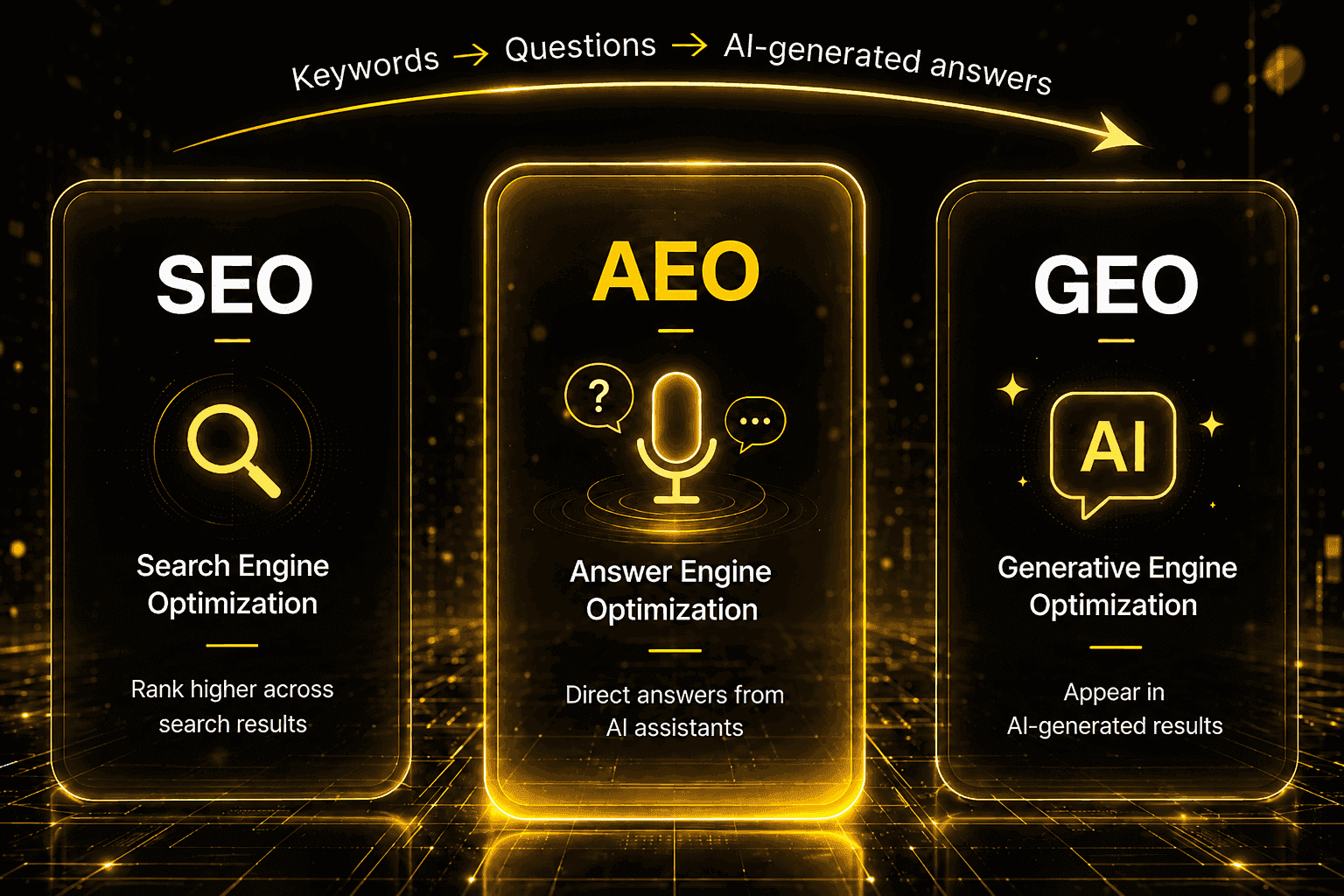
People increasingly ask an assistant instead of searching. The assistant answers, and sometimes it names a source.
Being that source is a different optimisation problem from ranking, and most sites are built for the old one.
What assistants are actually doing
Simplified: retrieve relevant passages, assess whether they can be trusted, synthesise an answer, and sometimes attribute.
Every stage has implications:
- Retrieval means your content must be findable and crawlable.
- Assessment means specific, verifiable claims beat vague ones.
- Synthesis means self-contained passages survive and context-dependent ones do not.
- Attribution means clear authorship and a site that looks like a real organisation.
Answer first, always
The single highest-leverage change.
Open every section and every FAQ with a complete sentence that answers the question. Not a wind-up, not context, not “there are several factors to consider”.
A model extracting an answer takes the first sentence or two. If those contain your answer, you get quoted. If they contain throat-clearing, the model moves to a source that got to the point.
This also happens to be better writing, which is convenient.
Passages have to stand alone
Assistants extract fragments, not documents.
A paragraph that only makes sense after the three before it cannot be lifted. One that carries its own context can.
Practically: repeat the subject rather than relying on pronouns across paragraph boundaries, avoid “as mentioned above”, and make each section resolvable on its own.
Specificity is a trust signal
Models weight checkable detail heavily, because it is the strongest available proxy for whether a source knows something.
Dates in absolute form. Named tools, standards and organisations. Real numbers. Specific mechanisms rather than general descriptions.
“Recent growth has been strong” is unquotable. “The network finalised 4.2 million transactions in March 2026” is exactly the kind of sentence that gets lifted.
Structure the machine can read
- Clean heading hierarchy, never skipping levels.
- Lists for enumerations of three or more items, because prose enumerations get truncated mid-extraction.
- Tables for comparisons, which assistants quote with high fidelity.
- Short paragraphs, since long ones are harder to extract cleanly.
Schema, and what it actually does
FAQPage, Article and Organization markup do not rank you. They remove ambiguity.
A model deciding whether a passage is an answer to a question is more confident when the markup says so explicitly. Clarity is what determines whether you get quoted, and schema is the cheapest clarity available.
Let the crawlers in
This is worth checking, because plenty of sites block AI agents by default or through a CDN rule nobody reviewed.
GPTBot, ClaudeBot, PerplexityBot, Google-Extended and the others need to be allowed in robots.txt if you want to be cited. Blocking them and then wondering why you are not quoted is a common and entirely self-inflicted problem.
An llms.txt file — a structured summary of what your organisation is and what your key pages cover — gives assistants a clean read on you rather than making them infer it.
FAQs are the highest-value format
An FAQ is a question and a self-contained answer. That is precisely the shape an assistant wants.
Write them as real questions people ask, phrased the way they would phrase them. Answer in the first sentence. Expand in two to four more. Keep each one able to stand alone.
Pages with well-written FAQ blocks get quoted far more often than pages without, and the reason is structural rather than mysterious.
What does not transfer from old SEO
Keyword density does nothing. Thin pages targeting keyword variations do nothing. Link volume matters far less than it does for ranking.
What matters is whether a passage answers a question accurately enough that a model is willing to put its name next to yours.
Common questions
What is answer engine optimisation?
Structuring content so AI assistants can extract, trust and cite it when answering a question. It overlaps with SEO and differs in an important way: search rewards pages that rank, while answer engines reward passages that can be quoted verbatim with confidence. That favours direct answers, specific verifiable facts, clean structure and named entities over keyword density.
How do you get ChatGPT to cite your website?
Answer questions directly in the first sentence, include specific checkable facts, structure content with clean headings and lists, publish FAQ markup, and make sure your site is crawlable by the AI agents. Assistants quote passages that stand alone without surrounding context, so a paragraph that only makes sense after three preceding ones will not get used.
Is AEO different from SEO?
They share most of the foundation - crawlable, fast, well-structured content - and diverge in what they reward. SEO optimises a page to rank in a list. AEO optimises a passage to be extracted as an answer. A page can rank well and never be quoted if its answers are buried, and a page can be quoted constantly without ranking first for anything.
Does schema markup help with AI search?
FAQPage, Article and Organization schema give machines an unambiguous read on what a passage is and who published it, which makes extraction more reliable. It is not a ranking lever in the traditional sense. It is a clarity signal, and clarity is what determines whether a model is confident enough to quote you.
Does Corum8 do AEO?
Yes, alongside SEO. We structure content for extraction, implement the schema, build the llms.txt and robots configuration that lets AI crawlers in, and write the direct-answer patterns assistants actually quote. Corum8 has run search and content programmes since 2016.