

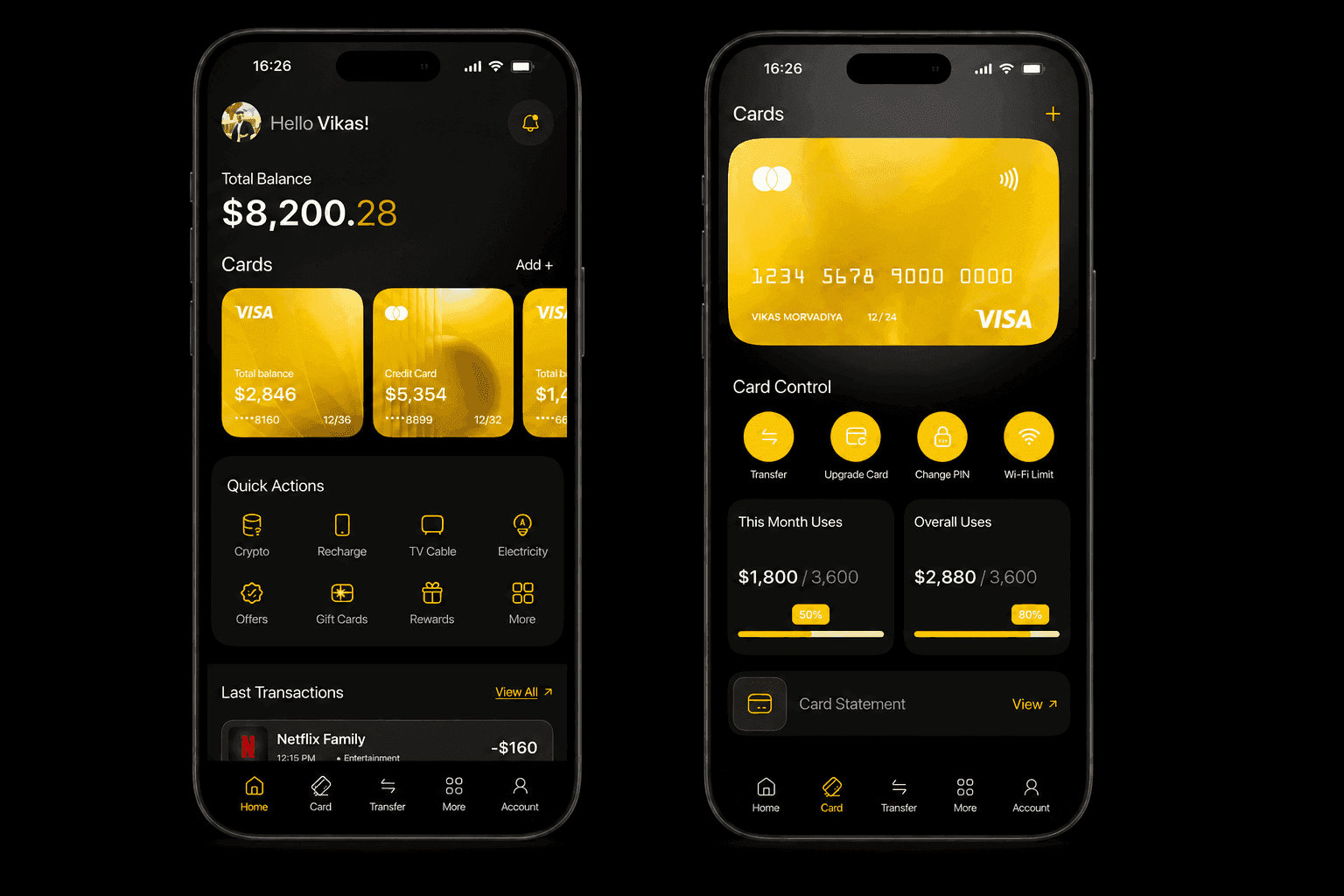
Most neobank projects start with the app. Screens, flows, a design system, an onboarding sequence somebody spent weeks polishing.
The app is the easy part. A neobank is a ledger with a customer interface attached, and almost everything that determines whether the business works sits behind the screens.
The ledger decides everything downstream
Start here, because retrofitting is brutal.
A neobank needs a proper double-entry ledger — every movement recorded as balanced entries, immutable, with the current state derived rather than stored and overwritten. This sounds like accounting pedantry until the first time you need to explain a discrepancy from six weeks ago.
What a well-built ledger handles without contortion:
- Holds and reversals, where money is committed but not yet settled.
- Fees and interest, accrued and posted on their own schedules.
- Multi-currency, with conversion recorded as two entries rather than a mutated number.
- Corrections, posted as new entries rather than edits, so history stays intact.
The version teams build under time pressure is a balances table with an update statement. It works fine until it does not, and when it fails it fails as an inability to answer basic questions about customer money.
Banking partners are an integration problem and a concentration risk
Your banking partner holds the actual funds and connects you to the payment rails. That relationship is commercial, and it is yours — we build the integration, you sign the agreement.
Two things matter architecturally.
Abstract the partner from the start. Build an internal interface for account operations and implement your partner behind it, rather than letting their API shape spread through your codebase. You will eventually add a second partner, either for redundancy or for a market the first does not serve, and the teams that hard-wired the first one pay for it heavily.
Reconcile continuously, not monthly. Your ledger and your partner’s records will drift — timing differences, failed callbacks, retries. A daily automated reconciliation that surfaces breaks immediately is standard. Discovering a break at month end means reconstructing weeks of activity.
Onboarding is a pipeline, not a form
The identity and onboarding flow is where most customers meet friction and where most of them leave.
Technically it is a state machine: submitted, verifying, needs-more-information, approved, rejected, under-review. Each transition needs recording with what triggered it and what evidence supported it, because someone will eventually ask how a particular decision was reached.
We integrate whichever identity providers you use — Sumsub, Jumio, Persona and similar — with case management on top so your operations team can work a queue rather than dig through provider dashboards. What those checks need to satisfy is set by your compliance team. We build the pipeline to their requirements.
The product decision that matters most: how much you let a customer do before they are fully verified. Too little and your conversion collapses. Too much and you create exposure. That is a call for your team, and the system needs to express whatever they decide.
The operations console is not optional
Every neobank build underestimates this, and every neobank team ends up living in it.
Your support and operations people need to look up an account, see its full history, understand why a transaction failed, place and release holds, work the onboarding queue, and handle disputes. Without a proper console they do this through database queries and provider dashboards, which is slow, error-prone and impossible to audit internally.
Build it alongside the customer app, not after launch.
Buy the foundation, build the product
Core banking platforms and Banking-as-a-Service providers give you a working base quickly, and for most teams that is the right call. The rails are not where you are different.
Custom engineering earns its place in the parts customers actually experience: the onboarding flow, the spending intelligence, the specific capability they came to you for rather than a traditional bank. That is the product. The infrastructure underneath it should be as boring and reliable as you can make it.
One team on the product and the launch
We build neobank infrastructure and run neobank launch marketing — brand, financial and consumer press, outdoor and social.
The practical benefit is that the campaign never announces a feature the ledger cannot support yet, because the people writing it can ask the people building it. That single fact prevents the most common and most damaging failure in a challenger-bank launch.
Common questions
What does building a neobank platform involve?
A double-entry ledger, an onboarding and identity pipeline, integrations into one or more banking partners, a payments and card layer, and the operations console your team runs the business from. The customer app is the smallest piece of it. Most of the engineering effort and almost all of the risk sits in the ledger and the reconciliation between your records and your banking partner's, because that is the part that has to be right every single time.
Why is the ledger the most important part of a neobank?
Because it is the record of who owns what, and every other system depends on it being correct. A double-entry ledger designed from the start handles reversals, holds, fees, interest and multi-currency without contortion. One retrofitted onto a simple balances table produces discrepancies nobody can explain months later. The cost of getting this wrong is not a bug, it is an inability to answer basic questions about customer money.
How many banking partners does a neobank need?
More than one, eventually. A single partner is simplest to launch on and becomes a concentration risk the moment your volume matters to them or their appetite changes. Most platforms that scale end up with a primary partner and at least one fallback, which means the integration layer has to be built to abstract them rather than hard-wired to whichever one you signed first. Designing for that from the start costs far less than migrating later.
Should a neobank build or buy its core banking stack?
Buy the parts that are identical for everyone and build the parts customers experience. Core banking providers and Banking-as-a-Service platforms give you a working foundation quickly. What they do not give you is the product itself - the onboarding experience, the spending intelligence, the specific flows your customers came for. That is where custom engineering earns its place, and where a neobank is actually differentiated.
What does Corum8 build for neobanks?
Ledger and account infrastructure, onboarding and identity pipelines, banking-partner and card-issuing integrations, the customer apps, and the operations console. We also run the launch marketing - brand, press, outdoor and social - which means the product and the story get built by one team. Corum8 has been building fintech infrastructure since 2016 with 95+ specialists.