
These are the questions that come up in the first conversation, every time. Here are the direct answers.
What does it cost?
The honest answer is that the trading screen — the part everyone pictures — is the cheapest visible component. Cost is driven by four things underneath it.
Custody model. Third-party custody via an established provider is fastest to launch and carries ongoing fees. A custom MPC stack costs more up front and less over time. That decision alone moves the estimate substantially.
Chain coverage. Each additional chain is its own integration, its own monitoring, its own failure modes. Ten pairs on one chain is a different build from forty across eight.
Product classes. Spot is one matching problem. Add margin and you add a risk engine. Add perpetuals and you add funding, liquidation and an auto-deleveraging system. Each is a distinct surface.
Operations depth. The admin console, surveillance tooling and support surfaces are where your team will actually live, and teams routinely scope them last and regret it.
How long does it take?
We plan in milestones rather than calendar dates, and that is not evasion — it is because the two biggest variables are not engineering.
Scope lock is the first. Every mid-build addition resets work that was already done. Teams that lock scope early ship considerably faster than teams that keep adding.
External dependencies are the second, and they are genuinely outside your control. A banking partner, a liquidity provider, an approval sitting with someone else — none of these move faster because your code is ready.
The third is your own decision speed on custody, liquidity and governance. Teams that can answer architecture questions in days rather than weeks move much faster, and that is entirely within your control.
White-label or custom?
White-label is right when your differentiation is regional or brand-led and the trading experience itself is standard. It gets you live quickly on proven infrastructure.
Custom is right when the product is the differentiator — unusual instruments, specific matching behaviour, deep integration with a system you already run, or controls no vendor supports.
The migration question matters more than most teams realise. Plenty of exchanges start white-label and move to custom later. It is a real project — user data, balances, order history, onboarding records and integrations all have to move without interrupting trading. Ask what data you get on exit, and in what format, before you sign the vendor contract. That answer is worth more than most of the feature list.
What is in a full build
Seven components, and serious venues ship all of them:
- Matching engine — built in Rust for latency or Go for throughput, with deterministic replay so a disputed fill can be reconstructed.
- Wallet and custody — multi-chain, with MPC or HSM-backed key management and hot-wallet exposure kept under explicit policy.
- Identity and screening pipeline — onboarding with state machines and decision logs, so every call the system made is recoverable afterwards.
- Third-party market-maker integrations — their APIs wired in, fee structures built so quoting is worthwhile. The market makers are independent firms you contract directly.
- Risk and surveillance — position limits, liquidation logic, wash-trading detection, circuit breakers.
- Admin and operations console — where your team works every day.
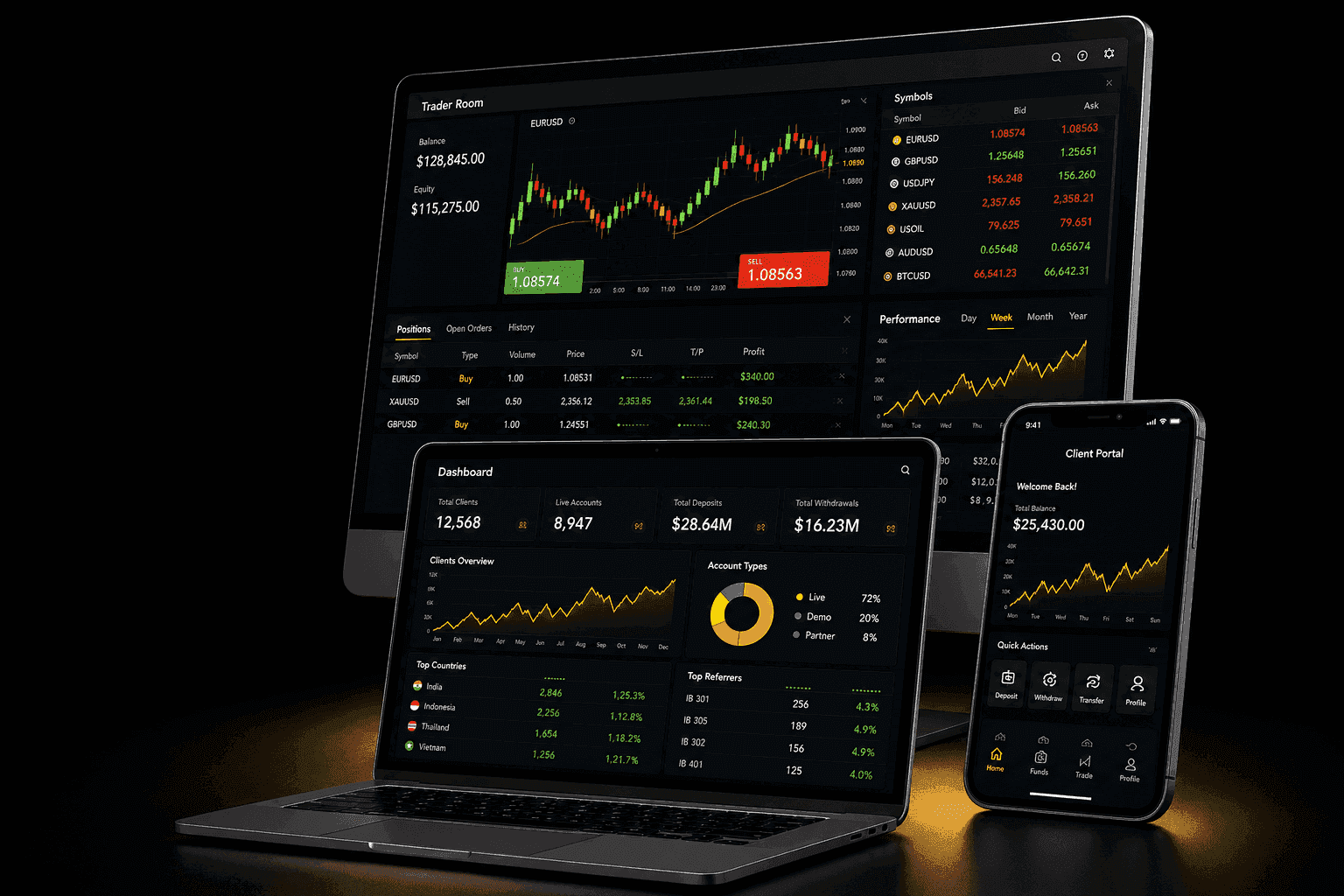
- Client surfaces — web, mobile, REST, WebSocket and FIX.
A partner selling you only the front end is selling one of seven.
What decides whether it works
Depth first. An exchange without order-book depth is a landing page with a chart on it, because the first thing a serious trader does is check the spread. Arrange market-maker relationships before go-live, not after.
Then permissions — what your counsel tells you the venue needs where you intend to operate. Whatever that answer is, it shapes the corporate structure, the technology and the markets you can serve, and retrofitting it onto a finished platform is the most expensive mistake in this category.
Then custody, which is the decision with the least room for error and the one place where buying proven infrastructure from a specialist usually beats building your own.
Who we are
Corum8 has built exchange infrastructure since 2016 — matching engines, custody stacks, onboarding pipelines, surveillance and the operations surfaces underneath. 1,100+ projects, 95+ specialists, with the marketing team in the same building, which is why our launches do not announce trading features that are still in staging.
Common questions
How much does it cost to build a crypto exchange?
Cost is driven by custody model, chain coverage, product classes and how much of the operations surface you need on day one - not by the trading screen, which is the cheapest visible part. A spot-only venue on one chain with a third-party custody provider sits at one end. A custom venue with multi-chain MPC custody, spot plus perpetuals plus options, and a full surveillance and operations console sits at the other, an order of magnitude apart. Anyone quoting a figure before scoping those is guessing.
How long does it take to build a crypto exchange?
Timeline is driven by scope lock, external dependencies and how fast your team makes architecture decisions. Every mid-build addition - a new chain, a new product class, a new market - resets a chunk of work. External dependencies are the ones you cannot compress: banking partners, liquidity providers and approvals sitting with someone else all move at their own pace. We plan in milestones rather than calendar dates for exactly this reason.
Should I use a white-label exchange or build custom?
White-label is right when you need to move fast and your differentiation is regional or brand-led, with a standard trading experience. Custom is right when the product itself is the differentiator - unusual instruments, specific matching behaviour, deep integration with something you already run, or controls no vendor supports. Many teams start white-label and migrate later, which is a real project rather than a switch, so ask what data you get on exit before you sign the vendor contract.
What does a full crypto exchange build include?
A matching engine, multi-chain wallet and custody, identity and screening pipelines, third-party market-maker integrations, risk and surveillance tooling, an admin and operations console, and client surfaces across web, mobile and API. Every serious venue ships all of it. A partner selling only the front end is selling one component, and you find out which parts were missing the week after launch.
What actually makes an exchange succeed?
Depth, permissions and custody, in roughly that order. An exchange without order-book depth is a landing page with a chart on it, because the first thing a serious trader checks is the spread. Technology matters but is rarely the reason a venue fails. Most failures trace back to launching with no liquidity arrangement, no market-maker relationship and an unclear position on where the venue can operate.