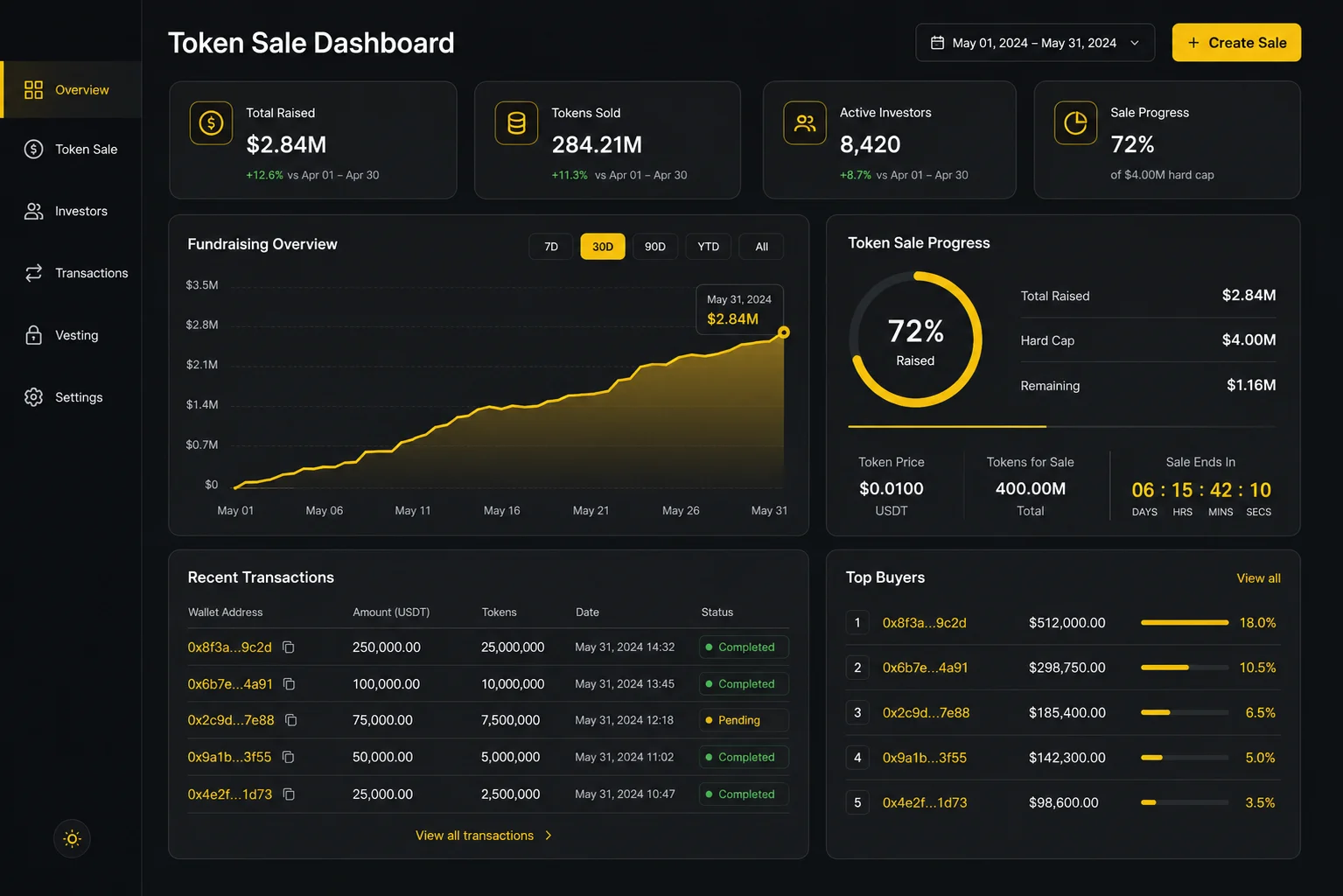


A token launch is fifteen decisions in a fixed order. The order is the part people get wrong.
Every step constrains the ones after it. Choose a jurisdiction and you’ve narrowed your distribution. Choose a vesting schedule and you’ve shaped who buys. Announce before either is settled and you’ve committed publicly to something you may need to change — in a market that screenshots everything.
Here’s the sequence.
1. Decide what the token is for
Not what it’s called. What it does that a database row couldn’t. Access, governance, fee capture, collateral, settlement. If the honest answer is that the token exists so there can be a sale, everything downstream gets harder, because every reader will reach the same conclusion you’re avoiding.
2. Settle the legal structure
Entity, jurisdiction, counsel opinion. This determines who you can sell to, how you can promote, and what you owe in disclosure. Which rules apply depends on where you are and what the token does, and separate regimes apply in the UK, Singapore and elsewhere. Several large markets are effectively closed without specific structuring.
3. Design the token
Total supply, emission schedule, allocation across team, investors, treasury, community and liquidity, and vesting for each. Model what happens when each cliff unlocks. If the chart shows a wall of supply arriving three months after listing, fix it now rather than explaining it later.
4. Choose the chain
Ethereum for credibility and depth of tooling. Solana for throughput and consumer applications. Base or Arbitrum for lower fees with Ethereum alignment. TON if your distribution runs through Telegram. Pick for where your users are, not for which chain has the best grant programme.
5. Build the contract
Standard patterns wherever possible — OpenZeppelin libraries exist because writing your own token logic is a way to introduce bugs nobody needs. If you include upgradeability, include a timelock, and be prepared to explain who controls it.
6. Audit
Freeze the code, then audit. Fix the findings, then get the fixes reviewed. Publish the whole report, including anything you chose not to fix and why. See our longer piece on what an audit does and doesn’t cover — the scope section is the part that matters.
7. Plan distribution
Who gets tokens, when, and under what conditions. Airdrops need sybil resistance or you’re funding farmers. Private allocations need paperwork. Community allocations need criteria you can defend publicly.
8. Plan liquidity
How much depth, on which venues, funded by whom. Get the market making relationship agreed before the token trades. Read those terms carefully — some structures hand the market maker options worth more than the service.
9. Build the community
Before the sale, not during it. A few thousand people who found you when there was nothing to buy are the most valuable asset in the whole launch, and they can’t be acquired retroactively.
10. Write the documentation
Whitepaper or litepaper, tokenomics breakdown, a one-pager, and an FAQ that answers the awkward questions directly. Buyers read these. Exchanges read them harder.
11. Secure private commitment
Real allocations from real parties before the public round opens. It gives press a checkable fact, reduces pressure on the public window, and changes the psychology for everyone who arrives later.
12. Run the public campaign
Press, KOL activation and community, concentrated against the dated moments rather than spread across a quiet period. This is where most of the visible spend goes and it’s the eleventh step, not the first.
13. Build the sale mechanics
The sale page, wallet flow, KYC through a provider like Sumsub, jurisdiction screening and geofencing, and support staffed to answer within minutes during the window. A sale page that falls over under load costs more than any line item in the campaign.
14. TGE and listing
Generation, distribution, DEX liquidity, then centralised venues in tier order. Have the holder communications written before the day, not during it.
15. Operate after launch
Vesting transparency, unlock communications published ahead of time, product delivery against what you said, and a community that still has a reason to be there. This is the step that decides whether the project exists in a year, and it’s the one that gets the least planning.
What drives cost and complexity
- Number of jurisdictions you sell into and the structuring each requires.
- Whether the token has securities-adjacent features — yields, revenue share, profit expectation — which changes the legal load substantially.
- Contract complexity and therefore audit depth.
- Launchpad versus independent, since each moves work between you and a partner.
- Languages and regions in the community and campaign plan.
- Liquidity commitment, which is capital rather than fees and is frequently the largest number in the whole exercise.
The one rule
Don’t announce until the structure is locked. Everything after that is execution. Everything before it is subject to change, and a market that has watched a thousand launches will read every revision as a warning.
For Cashaa, a campaign that raised $32M ran community, press and creator activity as one programme against one set of dates. That coordination is only possible when the dates are real, which is only possible when steps one through eleven are done.
Common questions
What is the correct order for launching a crypto token?
Purpose, legal structure, token design, contract build, audit, distribution plan, liquidity plan, community, documentation, private commitment, public campaign, sale mechanics, TGE, listing, and post-launch operations. The order matters more than any individual step, because each one constrains the next. Teams that start at the marketing step and work backwards end up redoing the earlier ones under time pressure, which is where most avoidable mistakes come from.
Do you need a legal opinion before launching a token?
For any token sold to the public, yes. A counsel opinion establishes what the token is in the jurisdictions you care about, which determines who you can sell to, how you can promote it, and what disclosures you owe. It also becomes a document exchanges and partners ask for later. Launching without one does not remove the legal question — it just moves it to a point where fixing it is far more expensive.
How much liquidity does a new token need at launch?
Enough that a normal-sized trade does not move the price violently, which depends entirely on your expected volume and the venues you list on. There is no universal number. What matters is having a market making relationship and a funded plan before the token trades, rather than discovering the depth problem from angry holders in the first hour.
Should you use a launchpad?
A launchpad brings distribution, an existing buyer base and a structured process, in exchange for allocation, fees and less control over terms. It suits teams without their own community and without the operational capacity to run a sale. If you have genuine demand of your own, running independently keeps more of the upside and all of the flexibility. Evaluate both against how much demand you can generate without help.
What is the most common token launch mistake?
Announcing before the structure is final. Every subsequent change to supply, vesting or utility reads as instability to a market that keeps receipts, and it compounds — each revision makes the next announcement less believable. Lock the design, get it reviewed, then talk about it. The urge to announce early is understandable and it costs projects more than almost any other single decision.