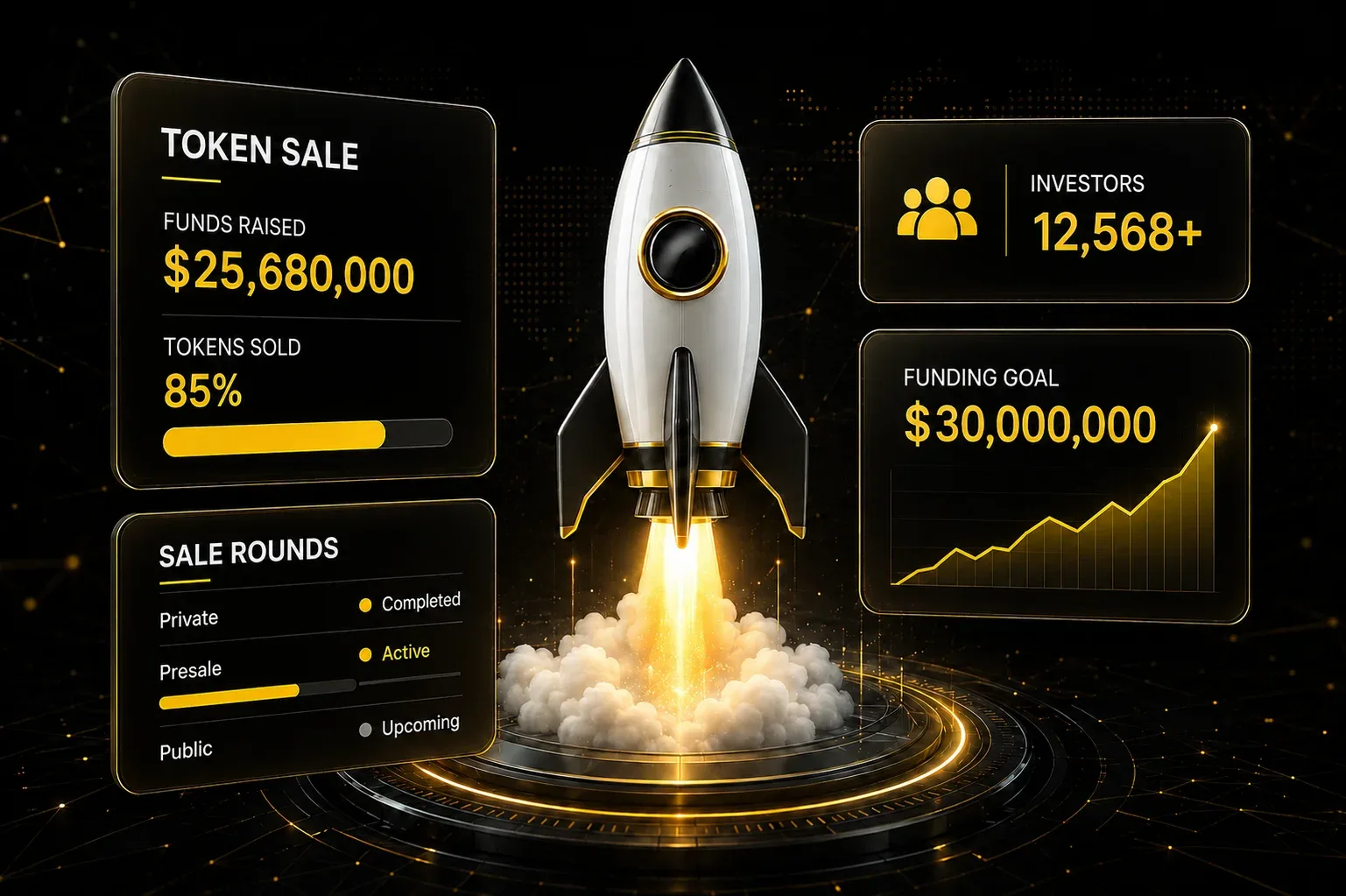

A token sale is a distribution problem wearing a marketing costume.
The campaign is the visible part. The part that decides whether it works happens months earlier, in decisions about supply, vesting, jurisdiction and who’s already committed before you open the doors. Get those wrong and no amount of budget rescues the raise.
The order the work has to happen in
Here’s the sequence that actually holds up, and the point at which marketing can start:
- Token design. Supply, emission, vesting, utility, and what the token does that a database row couldn’t.
- Legal structure and jurisdiction. Entity, counsel opinion, which markets you can sell into, which you have to geofence.
- Product proof. Something working, even if it’s narrow. A testnet with real usage beats a whitepaper with beautiful diagrams.
- Committed allocation. Private or strategic interest that’s real, so the public round doesn’t open at zero.
- Then marketing.
Teams that invert steps 1 and 5 produce a lot of assets that get binned. We’ve watched campaigns get rebuilt twice because the vesting schedule changed after the deck was out. That’s not a marketing failure. That’s the sequence being wrong.
Signals you’re ready to market a sale
Tokenomics are locked and reviewed. Not draft. Locked, with counsel having looked at them.
You can answer the utility question in one sentence. If the honest answer is that the token exists so there can be a sale, the campaign will struggle, because everyone reading it will spot the same gap.
There’s something to use. A live testnet, a working beta, a contract on mainnet. Buyers in 2026 are far more product-literate than in previous cycles.
You have a community that predates the sale. Even a small one. A few thousand people who found you before there was a token to buy are the most valuable asset in the raise.
Jurisdiction is settled. You know where you can sell, where you can’t, and the geofencing is built rather than promised.
Signals you’re not
The token model is still being argued about internally.
There’s no product and no testnet — just a roadmap.
Your entire distribution plan is a list of KOLs and a launchpad application.
You’re planning to announce partnerships that haven’t been agreed. This one ends badly more often than founders expect, and it’s the kind of thing that surfaces exactly when you least want it to.
What the campaign actually consists of
A token sale campaign isn’t one thing. It’s five workstreams running against the same date:
Narrative. One sentence that explains why this exists, that survives a hostile reading. Everything else derives from it. If the founder and the CTO give different answers to the same question in two different interviews, that’s a narrative problem and it will get noticed.
Documentation. Whitepaper or litepaper, tokenomics breakdown, a one-pager, and an FAQ that answers the awkward questions honestly. Buyers read these. Investors read them more carefully than you’d like.
Community. Built before, staffed during, and retained after. The retention part is where most sales lose momentum.
Press and KOL. Concentrated around the dated moments — round opening, milestone hits, close, TGE, listing. Diffuse coverage across a quiet period is wasted.
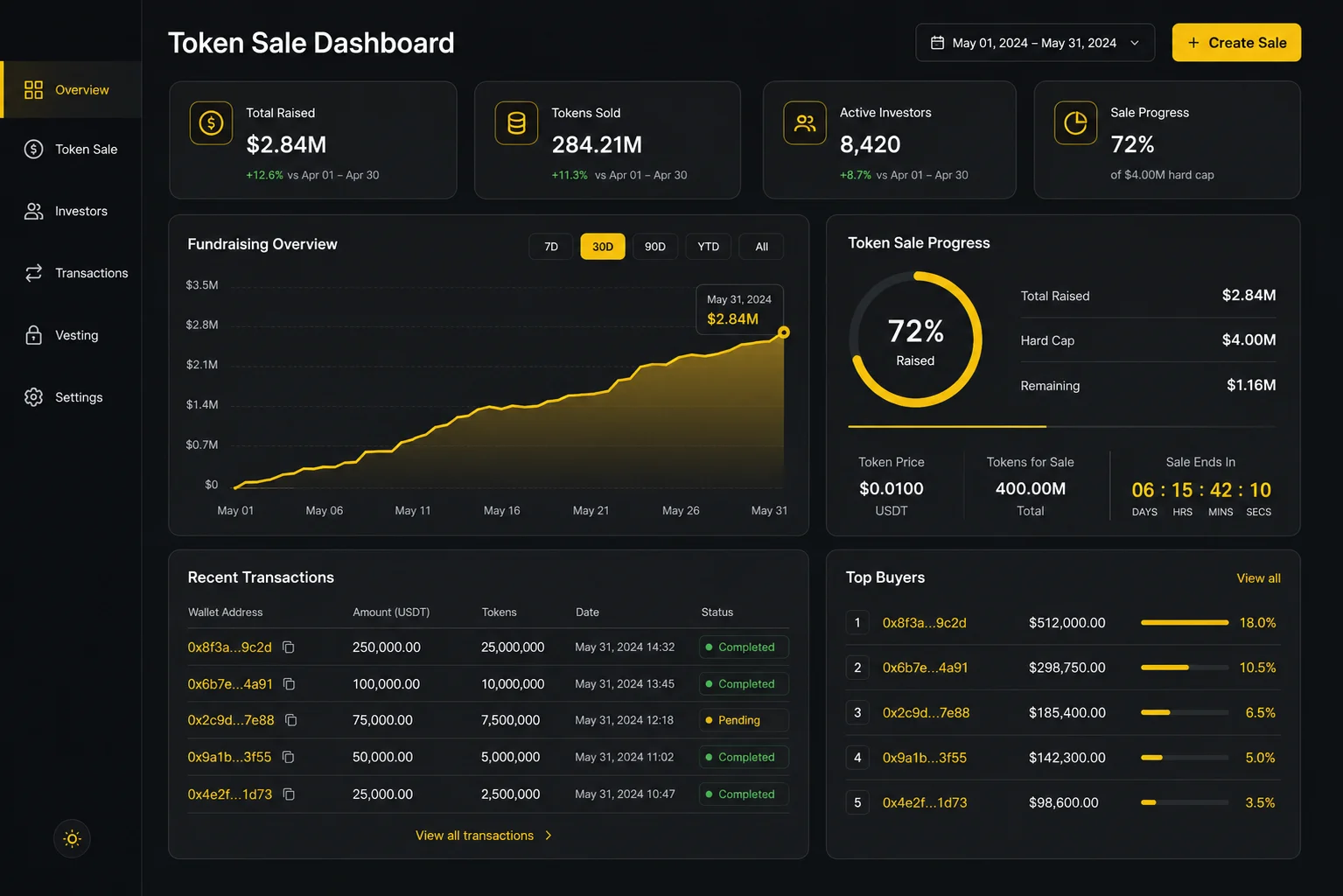
Sale mechanics. The page itself, the wallet flow, KYC integration through a provider like Sumsub, jurisdiction screening, and a support channel that answers within minutes during the window. A sale page that breaks under load costs more than any campaign line item.
Common mistakes
Marketing to traders instead of holders. The audience you attract determines the chart after listing. Campaigns built entirely on price expectation deliver exactly the holders you’d expect.
Announcing the round before the structure is final. Every change after the announcement erodes trust, and crypto audiences keep receipts.
Hiding the vesting. Publish it. Clearly. The projects that get punished are the ones where the community discovers a cliff nobody mentioned.
Treating TGE as the finish line. It’s the start of the part that determines whether the project survives.
What drives cost and complexity
We don’t publish a flat number for token launch work because the variables genuinely dominate:
- How many jurisdictions you’re selling into, and how much structuring each requires.
- Whether the token touches securities-adjacent features — revenue share, profit expectation, staking yields — which changes the legal and compliance load substantially.
- Number of languages and regions in the community and KOL plan.
- Whether you’re running through a launchpad, which brings its own requirements, or independently, which means you build all of the mechanics yourself.
- Product maturity. A team with a live product needs a fraction of the narrative construction of one selling a plan.
- Post-TGE scope. Listing support, market making relationships and liquidity depth are separate workstreams with their own drivers.
What we’ve seen work
For Cashaa, the campaign that raised $32M ran community, PR and KOL activity as one programme against a single set of dates, not three separate agencies pulling in different directions. For Obortech, community building, influencer work and listing services supported two rounds totalling $2.3M — and the project went on to work with enterprise clients, which is the part that matters more than the raise number.
The pattern in both: the sale was the visible event, and the work that made it possible started well before anyone saw a countdown timer.
If you’re at the stage where the token model is still moving, spend the next stretch there instead. Marketing a settled token is a normal job. Marketing a moving one is an expensive way to produce drafts.
Common questions
When should token sale marketing start?
Marketing starts after the token design, legal structure and jurisdiction are settled, not before. The single most common cause of a failed sale is a campaign built around a token model that changes mid-flight. Once supply, vesting, utility and the sale structure are locked and reviewed by counsel, you have something to market. Until then, every asset you produce has a good chance of being thrown away.
What is the biggest reason token sales fail?
No pre-existing demand. Teams treat the sale window as the moment to create interest, when the sale window is really where existing interest converts. If you arrive at your public round with no community, no press footprint and no committed allocations, the campaign is trying to manufacture belief in a few weeks. That almost never works, regardless of budget.
Do you need a private round before a public sale?
Not always, but committed allocations before you open publicly change the dynamics enormously. They provide social proof, they reduce the pressure on the public window, and they give press a verifiable fact to write about. A public round opening at zero commitment is a much harder sell than one opening with a meaningful portion already spoken for.
Which jurisdictions matter for a token sale?
The ones where your buyers actually are, plus wherever your entity sits — and your counsel decides what each of those allows. Several major markets are effectively closed to a token sale without specific structuring, which is worth knowing before you build an audience there rather than after. The part worth internalising on the marketing side: geofencing and market screening are engineering work, not a disclaimer in the footer.
What happens after the sale closes?
The part most teams underplan. Listing support, liquidity depth, holder communications, vesting transparency and a working product roadmap all land in the weeks after TGE, and that is when a community either consolidates or dissolves. Budget for the period after the raise, because a sale that closes well and then goes quiet undoes most of what the campaign bought.